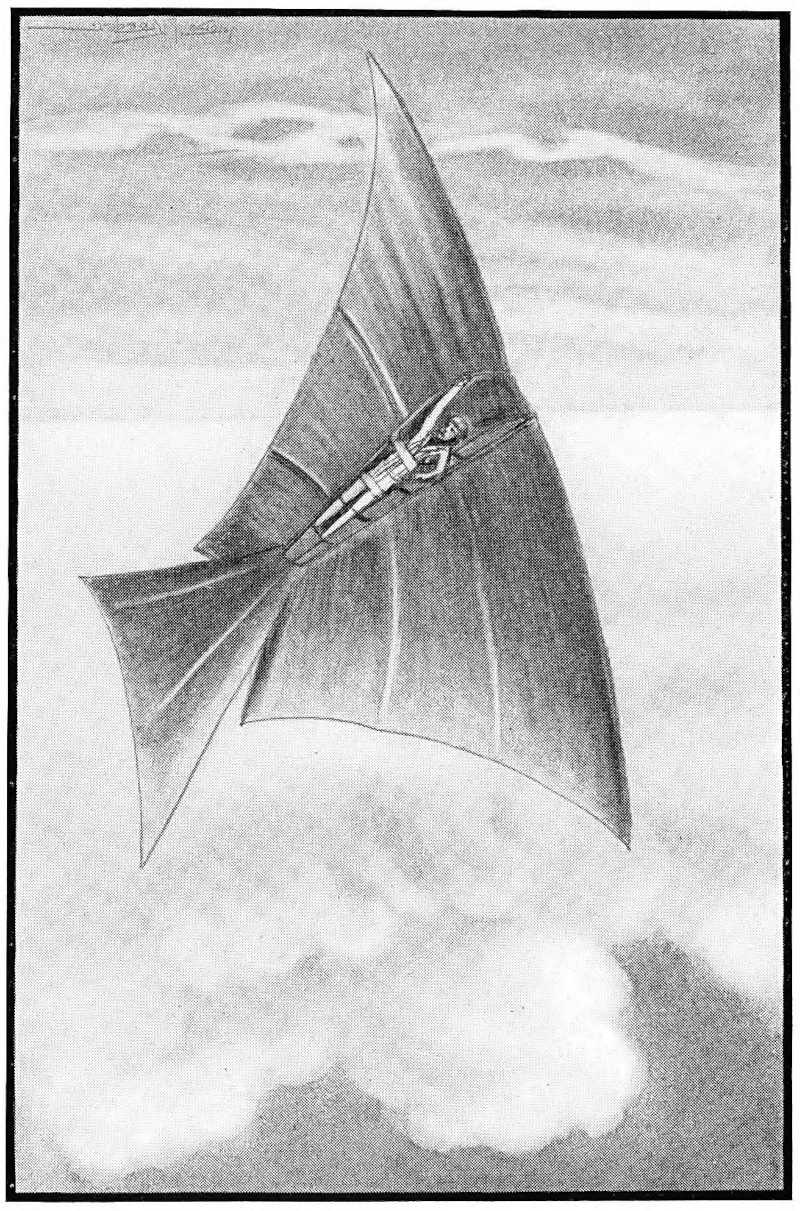
Then the Bat was seen to drop suddenly.
See page 76
OR
A YOUNG ACROBAT IN THE CLOUDS
BY
VANCE BARNUM
Author of “Joe Strong, the Boy Wizard,” “Joe Strong on the Trapeze,” etc.
ILLUSTRATED
NEW YORK
HEARST’S INTERNATIONAL LIBRARY CO.
PUBLISHERS
BOOKS FOR BOYS
BY
VANCE BARNUM
THE JOE STRONG SERIES
12mo. Cloth Illustrated. Price per volume, 60 cents, postpaid.
JOE STRONG, THE BOY WIZARD
Or, The Mysteries of Magic Exposed
JOE STRONG ON THE TRAPEZE
Or, The Daring Feats of a Young Circus Performer
JOE STRONG, THE BOY FISH
Or, Marvelous Doings in a Big Tank
JOE STRONG ON THE HIGH WIRE
Or, Motor-Cycle Perils of the Air
JOE STRONG AND HIS WINGS OF STEEL
Or, A Young Acrobat in the Clouds
Copyright, 1916, by
Hearst’s International Library Company
JOE STRONG AND HIS WINGS OF STEEL
[Pg iii]
CONTENTS
| CHAPTER | PAGE | |
|---|---|---|
| I. | A Queer Machine | 1 |
| II. | Tangles | 10 |
| III. | A Setback | 18 |
| IV. | Under Canvas Again | 28 |
| V. | In the Tank | 36 |
| VI. | A New Act | 45 |
| VII. | Jealousy | 53 |
| VIII. | The New Wings | 60 |
| IX. | An Accident | 69 |
| X. | Success at Last | 77 |
| XI. | Joe’s Surprise | 86 |
| XII. | The Runaway Balloon | 94 |
| XIII. | Rescued | 102 |
| XIV. | The Aviation Meet | 111 |
| XV. | Joe’s Plan | 119 |
| XVI. | The Prize Race | 127 |
| XVII. | The Old Inventor | 136 |
| XVIII. | A Prisoner | 146 |
| XIX. | A Dangerous Plight | 154 |
| XX. | Suspicions | 163 |
| XXI. | A Queer Offer | 173 |
| XXII. | The Hotel Fire | 184 |
| XXIII. | A Perilous Flight | 193 |
| XXIV. | Revelations | 201 |
| XXV. | New Plans | 210 |
ILLUSTRATIONS
| Then the Bat was seen to drop suddenly | Frontispiece | |
| FACING PAGE |
||
| Nearer and nearer he came to the floating balloon | 108 | |
| There the rescuers, somewhat overpowered by the strong and sickening odor, saw Joe lying in a heap on the floor | 166 | |
| Joe glided down in the Bat as the men on the roof rushed toward him | 202 | |
[Pg 1]
JOE STRONG AND HIS
WINGS OF STEEL
“This is where you’ve been hiding yourself, is it, Joe?”
“Yes, I’ve been practically living here for the last month or so, supervising my new machine, Benny. Come in and I’ll show it to you. And you too, Bill. You may be interested.”
“Does it work?” asked the man addressed as Bill, a stout, good-natured looking, and jolly individual, who, accompanied by a youth, had called at a certain factory to see Joe Strong.
“Work? Well, I hope it will, Bill,” answered Joe. “But it isn’t in shape for trial yet. I hope to have it completed, or nearly so, in a week. Then I’ll give you a real exhibition.”
“You’re great on exhibitions,” returned Benny Turton, laughing.
[Pg 2]
“Yes, I like ’em,” admitted Joe with a smile. “But come in. Mr. Brader has about given me the run of his factory, and I can take you all through, though I guess you’ve seen most of the stuff here.”
“Yes, circus apparatus isn’t new to either of us,” said Bill Watson, who was a veteran clown. “But we’re interested in your new machine, Joe.”
Joe Strong, who on hearing that his two friends from the Sampson Brothers’ Show, where he had formerly performed, would be in the neighborhood where the new apparatus was being made, had invited them to come to see it, and they had taken advantage of his offer.
Led by Joe, Bill and Benny followed through the big factory, which was a humming hive of industry, for Mr. Brader was one of the largest manufacturers of circus apparatus in the country.
Joe unlocked a door and admitted his friends to a room partitioned off from the main part of the factory.
“The men aren’t working on my machine just at present,” he said. “We had to send off to get certain parts, and there’s a delay. But it is so nearly completed that you can get an idea of what it will do. Here she is!”
He threw open the door, and for a moment neither Ben nor Bill said anything. They just stood looking at the queer machine.
Finally Bill asked:
[Pg 3]
“What’s it for?”
“Flying,” answered Joe.
“Humph!” mused the veteran clown. “You’ll break your neck, Joe Strong, if you try to fly with wings like that. Don’t risk it!”
“That’s right, Joe,” chimed in Benny Turton. “I don’t know what this machine is, but you sure do take too many risks. Your trapeze work was bad enough——”
“But it wasn’t anything to the way he rode his motor-cycle on the high wire,” put in Bill. “And now he’s going to do something even more dangerous.”
Joe regarded his friends with smiling face.
“You’re not giving me a chance to explain,” he said. “I don’t believe my wings of steel will be any more dangerous than riding the motor-cycle on the high wire was.”
“Wings of steel, eh? Is that what you call them?” asked Benny Turton.
“Yes, that’s as good a name as any, and if you’ll come closer and look you’ll see that the wings are really of light sheet steel, almost as thin as paper, but very strong. Take a look.”
The two visitors came closer to the queer apparatus. They saw a sort of cage, made of metal and of leather thongs. On either side of this cage extended a bat-like wing of thin curved steel, as thin almost, according to Joe, as a sheet of paper. [Pg 4]But the wing was braced and reinforced by spreading ribs of metal, as the bones of a bat’s wing hold that membrane extended.
The wings were hinged to the middle frame, and as Joe touched the thin leaves of metal they rose and fell at his touch, creating a little breeze in the workroom.
“Is that how it operates?” asked the clown. “Are you going to work the wings up and down by your hands and arms?”
“No, indeed,” Joe answered. “I couldn’t get enough power that way. Here is what operates them.”
He showed his friends two spaces down in the lower part of the framework.
“Powerful storage batteries of a new type are to go in there,” Joe explained. “And they operate motors which will vibrate the wings up and down.”
“Then you’re really going to fly like a bird?” asked Ben.
“Well, I hope to. Of course I can’t be sure about it until I make the test. I’m waiting now for the motors. They have been delayed, but I expect them in about a week, and then I’ll make a trial flight.”
“Going to invite us to see it?” asked Bill.
“I’ll be glad to have you come,” said Joe.
The old clown shook his head.
[Pg 5]
“I like you too much, Joe, to see you smashed to pieces,” said the veteran laugh-maker. “I guess I’ll stay away.”
“I won’t be dashed to pieces,” declared Joe. “The trouble is going to be—if there is any—in going up, not in coming down.”
“How do you make that out?” asked Ben. “I thought the descent was where the most trouble was in flying stunts. As the Irishman said, it wasn’t the falling that hurt, it was the stopping that made all the mischief.”
Joe laughed.
“I don’t believe I’ll have that trouble,” he said. “As I told you, I’ll be all right if I can make my wings of steel raise me from the ground. Then even if my motor should stop unexpectedly I would just have to glide down as a bird soars.”
“Oh, that’s why you feel you won’t be hurt,” said the clown; “your wings of steel will be like a parachute.”
“Something, yes,” conceded Joe. “So you needn’t have any fear of coming to see me perform.”
“Well, under that condition I’ll come,” agreed Bill, and Benny said he would also.
“This must be costing something,” observed the clown. “They can’t make single machines like this for a few dollars.”
[Pg 6]
“It is costing me a pretty penny,” said Joe. “But it’s an idea I’ve long had in mind, and I wanted to carry it out.
“I’ve put a large part of what I got from my mother’s estate in England into this machine, and I expect to put in more when I get the rest of what is coming to me. That will be along soon, and I’ll just about need it. This experimenting eats up cash. I had to have everything made to order. There wasn’t a single thing I needed carried in stock.
“It was while I was riding my motor-cycle in the circus one day that I got my idea of wings of steel,” Joe went on to explain. “I thought how fine it would be if I could glide like a bird.”
“Why didn’t you get an aeroplane?” asked Bill. “They’re quite common now—almost as common as automobiles, and there are even schools where they teach one to fly.”
“That’s the trouble,” said Joe. “They’re too common. There isn’t enough of novelty about them. I wanted something that would draw a big crowd.”
“Then you’re going to give exhibitions with your wings of steel—I mean public exhibitions?” asked Benny Turton.
“I hope to.”
“And will you come back to the circus?” asked Bill.
[Pg 7]
“Well, I don’t know about that,” said Joe slowly. “I can’t tell what I’m going to do until I find out if my machine is going to be a success. That’s the main point.”
“Let’s see how you look inside it,” suggested Ben, and Joe took his position within the queer framework, and slipped his arms into loops on the underside of the wings of steel.
“I can move them by hand power, just to give you an idea how they work,” he said, as he vibrated the big wings, and a breeze came, so strong that it blew off the clown’s straw hat.
“Say, you’ve got some power there, Joe!” the laugh-maker commented.
“I’ll need it,” asserted the young inventor. “It’s going to be no easy task to raise me and the machine off the earth. Once we’re up, though, the gliding motion will sustain me, just as a thin sheet of tin will scale through the air.
“You see I can steer myself by working one wing faster than the other, for each one will have a separate motor. I also have a small rudder down here, or, rather, two rudders. I control them with my feet. One is for steering from side to side, and the other is the elevation rudder. By deflecting it one way I can go up, and by reversing it I glide down.”
“It sounds easy,” said Ben, but there was doubt in his tone.
[Pg 8]
“Joe, you sure have ideas,” commented Bill. “But I wouldn’t take the risks you do—not for a good many thousand dollars!”
“Well, if this thing works right, I’ll be a good many thousand dollars in pocket,” Joe said. “I’ll take in big money by going about the country giving real flying exhibitions—not circling around in an airship or an aeroplane—though they’re wonderful enough; I don’t mean to say anything against them.
“But my wings of steel will be different. I want to resemble a big bird as nearly as I can, and I think therein will be the great novelty.”
“Yes, it will be novel all right,” admitted Bill.
Joe then gave a further demonstration of his queer apparatus—that is, as good a demonstration as he could under the circumstances. The two visitors looked at it on all sides, but neither one had very much faith in Joe’s plan.
“You’d better stick to the motor-cycle,” said Benny Turton. “As for me, the tank where I play a human fish is good enough for me.”
Joe crawled out of the framework, and pointed out some other mechanical appliances on his apparatus. As he was locking the workroom preparatory to accompanying his two friends outside, a messenger handed him a letter.
“Ha! Maybe this is what I’ve been waiting for,” he said. “Word of the motors being completed.”
[Pg 9]
Then, as he looked at the stamp and saw a foreign one on the envelope, he said:
“Why, this is from England! I guess they’re sending me the rest of my money. Well, it will come in handy.”
He opened the letter quickly. A hasty glance through the contents caused Joe to utter an exclamation; and it was not one of joy.
“What’s the matter?” asked Bill Watson.
“Bad news,” replied Joe quietly. “Very bad!”
[Pg 10]
For a moment Bill and Ben hesitated, and each, in his own mind, pondered whether it would be better or not to leave Joe alone for a while, and allow him to settle his own affairs. And then the fellowship that seems to exist among persons who perform together for the amusement of the public asserted itself, and Bill asked sympathetically:
“Is there anything we can do, Joe? Is it bad news about your new machine? Can’t they make it for you—I mean finish it?”
“Oh, it isn’t that,” Joe said. “This letter is from a lawyer in England who was looking after my affairs. He says my mother’s estate is badly tangled up, and it is doubtful if I ever get any more money out of it, and I may be sued for taking what I have already had.”
Benny Turton whistled.
“That’s hard luck!” he exclaimed. “Why, I thought everything was going smoothly. I don’t see how they can take back what you have already had.”
[Pg 11]
“They’ll have their own troubles getting it,” said Joe, “as most of it has been spent on my wings of steel. But of course if the courts decide that I had no right to it, I will have spent it wrongfully, and I’ll be liable to punishment.”
“Why, I thought the lawyer for the mining syndicate that Mr. Craige represented handled your affairs,” said Bill Watson.
“He did at first,” Joe answered, “but he had to turn my legal matters over to some one who was not so busy as he. A Mr. Kent Bolling now has charge, and this letter is from him. The whole affair is all mixed up. I’ll have to write him a letter at once and ask what can be done.”
“Then we’ll leave you,” said Ben. “Come to the circus when you can, Joe. We’re playing a straight week in Wharton, and you may find time to run over. Wharton is only ten miles. We came on the train to-day, but you can make it on your motor-cycle.”
“Yes, I’ll try to get over,” promised Joe. And then, bidding his friends good-bye, he went to his boarding place to pen a letter to the English solicitor.
And while Joe is doing that just a moment will be taken to acquaint new readers with something of the history of Joe Strong, as it has been given in the previous books of this series.
In the first volume, entitled “Joe Strong, the [Pg 12]Boy Wizard; Or, the Mysteries of Magic Exposed,” it is related that Joe, having run away from home, fell in with a stage magician, Professor Rosello, and went on the road with him, doing tricks. Joe was particularly fitted for this, as his father, Alexander Strong, known as Professor Morretti, had been a magician himself.
The boy’s mother, whose maiden name was Janet Willoughby, had learned to ride spirited horses in England, where she was born. She afterward came to America and joined a circus, she and her husband sometimes traveling together and again in separate shows.
So Joe inherited dexterity and daring. He became an expert sleight-of-hand worker, and learned to do many circus tricks. He was fearless and nerveless, and he could as easily balance himself on his head on top of the church spire as he could down on the ground.
Joe’s father and mother had died when he was small, and he was brought up by a rather strict man, Deacon Amos Blackford, from whom he later ran away.
After various adventures on the road with Professor Rosello, Joe Strong joined Sampson Brothers’ Circus and became one of the performers. In the second volume, named “Joe Strong on the Trapeze; Or, the Daring Feats of a Young Circus Performer,” the story of Joe’s life in the circus [Pg 13]is given. It was an exciting one. He made friends and enemies, and among the former were Bill Watson, the veteran clown, who had known Joe’s mother; Benny Turton, who performed in a big glass tank of water, and was known as the human fish; and Helen Morton, a pretty bareback rider.
Joe became an expert on the trapeze and flying rings, and it was while with the show that he once showed how long he could stay under water in Benny’s glass tank.
In the third volume, “Joe Strong, the Boy Fish; Or, Marvelous Doings in a Big Tank,” we find Joe taking the place of Benny Turton, who became incapacitated through illness.
Joe had many adventures while acting as the “boy fish.” He improved Ben’s act greatly, and learned to stay under water for nearly five minutes at a stretch. This served him in good stead once when a diver was caught in an outlet pipe at the bottom of a big reservoir.
From a stranded circus juggler Joe bought a motor-cycle. He became an expert rider, then had an idea that he could do some thrilling tricks with the gasoline-bicycle. In the fourth book, called “Joe Strong on the High Wire; Or, Motor-Cycle Perils of the Air,” we find Joe perfecting the feat of riding his machine across an open space on a suspended wire.
But this was not the only feat the lad did, for [Pg 14]he climbed up the outside of the Flatiron Building in New York, for a moving picture concern, and rode across a street on a wire stretched from one high building to another.
Joe left the circus for a time, but came back to it to give exhibitions of his motor-cycle riding, and it was while on the road that he received information which enabled him to claim some money from England. His mother, it appeared, was heir to part of a large estate. She had been disowned by her family when she married Mr. Strong, but at the last her father forgave her, and expressed a wish to have her share in his money.
While on his motor-cycle one day Joe was able to save from severe injury, if not from death, two Englishmen, Mr. Forrest Craige and Mr. Floyd Strailey, and it was Mr. Craige who helped our hero to obtain his inheritance.
With the money he received Joe was able to carry out a long-cherished scheme—that of building for himself wings of steel, a partial account of which has already been given in the present volume.
The youth had left the circus at the close of the previous season, when the show wintered in one of the Southern states, in order to devote his time to building his queer flying machine. Now it was nearing completion.
The circus was again on the road, but Joe was [Pg 15]not with it, though he thought he might rejoin it at some future time. Among the reasons for this, aside from earning his living, was the fact that Joe was very fond of Helen Morton, and he had a faint idea that some day he might be able to manage matters so she would not have to perform in public, as a circus environment is not always best for a girl, though there are many noble men and women in the profession.
At any rate, Joe’s wings of steel were now nearly finished, and he had great hopes of what he could do with them by giving exhibitions in public, as he had done when he rode his motor-cycle on the high wire.
“But if what this lawyer says is true, and I am to get no more money from mother’s estate, and, not only that, but have to pay back what I have already used, then good-bye wings of steel!” said Joe gloomily, as he again read the epistle from England. “Let’s see what it is he says,” he mused.
In brief the letter, which was from another attorney than the one who originally had the case, stated that one of the heirs under the will of Mr. Willoughby, who was the father of Joe’s mother, had objected to our hero sharing in the estate, and announced his intention of making Joe pay back the money received.
“I wonder what’s the matter with him, anyhow,” mused Joe as he glanced over the letter. “This [Pg 16]objecting heir got a bigger share than any one else, and yet he isn’t satisfied. He wants mine, too. There is bound to be a lot of litigation over the matter, so this lawyer says,” went on Joe gloomily; “and lawsuits cost money. I wish I were rich enough to go over there and find out things for myself. It isn’t any fun to have to be writing letters back and forth. But it’s the only way. I’ve spent nearly all my spare cash on that machine. If that is a failure, I’m ‘up the spout,’ as the Dutchman said.
“Well, the only thing to do is to keep on and see where I come out. I ought to get the motors in a few days, and then we’ll see what can be done.”
When he had first had his idea for the wings of steel, which he thought would enable him to give even a more spectacular performance than he had given with his motor-cycle on the high wire, Joe had gone to Mr. Brader, the manufacturer who had made his first apparatus, to have him build the flying machine.
At first Mr. Brader, who manufactured much special apparatus for circus performers, had said Joe’s plan was not feasible. But the young performer had insisted on having what he wanted, and as he had made a working plan for the machine, the manufacturer set his men to work on it in his factory.
“And now it’s all but done,” said Joe, as he sat [Pg 17]down to write to the English solicitor. “Only Ben and Bill seem to think I’m going to break my neck with it. Well, I’ll show them that it’s perfectly safe. I’ll soon be flying up near the clouds. It will be great!” And, for the moment, his exultation drove away his gloomy feeling concerning the possible loss of his money.
Joe wrote to the solicitor, urging him to do his best to secure the rest of our hero’s inheritance for him. He explained why he wanted it, and said it did not seem fair to make him pay back what he had already been given, even if no more were forthcoming.
“There! We’ll see what comes of that!” the lad exclaimed, as he went out to post the letter. “I wish Mr. Craige’s lawyer had charge of the case, instead of this Mr. Bolling. I wonder if I can trust him? I must make some inquiries.”
And then, there being nothing further Joe could do, he decided to ride over on his motor-cycle that afternoon to visit some of his circus friends.
[Pg 18]
Preparations for giving the evening performance of the circus were under way when Joe arrived. He left his motor-cycle with one of the men he knew and then proceeded to look for Helen, Benny or some others of his friends. Benny was on his way to the dining tent, but as Joe saw Helen at the same time that he had a glimpse of the human fish, it can be imagined in which direction the lad walked. Ben called to him, however:
“Well, did you cable your lawyer to hustle that money over to you right away, and quit fooling?”
“I wish I could have done that,” Joe answered, “but I wrote him a stiff letter.”
“Good!” exclaimed Ben. “See you later. Will you come over and have a bite?”
“Not now, thanks.”
Joe greeted Helen with a smile.
“I see you are still alive,” she murmured as she shook hands with him.
“Why shouldn’t I be?” asked Joe, with a puzzled look.
[Pg 19]
“Well, I didn’t know, from what Ben and Bill told me, but that you might be trying to fly over to see us, and if you did you might have fallen on the way.”
“Not quite so bad as that, Helen.”
“Joe, are you really going to trust yourself to those wings of steel?”
“I am, if I can get them to work.”
“You’ll use a life-net, won’t you, as you did in your motor-cycle act?”
“I can’t very well. You see I expect to cover a good bit of space when I fly up and soar around, and it would have to be a pretty big net to catch me if I fell.”
“But what if you do fall, Joe?” and Helen seemed quite anxious.
“Oh, I’m not going to fall,” he told the pretty bareback rider. “I’ve faith enough in my machine for that. But it isn’t in working order yet. Now let’s talk about yourself. How are you, and how is the nice horse?” for Helen had a steed named Rosebud, of which she was very fond, as was Joe.
“Oh, Rosebud is all right. I’m just on my way to give him his sugar allowance. Want to come with me?”
“I most certainly do.”
A little later Helen and Joe were in the animal tent, and Rosebud was rubbing his velvety muzzle [Pg 20]first against the youth and then against Helen’s hand, as she fed him the lumps of sugar.
“That’s his reward for being good to-day,” Helen said with a smile. “I never had him act better in the ring, and I put him through some new tricks for the first time in public this afternoon, too.”
“That’s nice. How is the show going, by the way?”
Helen paused a moment before replying. Then she said:
“Well, Joe, to tell you the truth, it isn’t going as well as it did when you were with it last season.”
“Is that so? I hope my leaving didn’t have anything to do with it, Helen.”
“Well, we miss you, of course; but you see we’re on a new circuit, and playing in sections of the country where there isn’t such a large population as we’re used to. We’re not getting the crowds we are in the habit of playing to, and I think the management is beginning to feel it.”
“Is Jim Tracy worried?” asked Joe, referring to his good friend, the ring-master, who was one of the owners of the show.
“Yes, I think he is. We all are, in fact, for of course our salaries depend on the money the circus takes in. I’m better off than some, for you know I have my little inheritance from grandfather’s estate to fall back on. But some of the performers [Pg 21]haven’t saved anything, and if the show fails——”
“Oh, it won’t do that!” interrupted Joe quickly. “Can’t Jim change the route so as to get into a better section of the country?”
“He’s thought of that, he told me. But the trouble is that the other good routes are taken up by other circuses, and you know it isn’t much use to follow a show in a city.”
“That’s right,” Joe admitted. “Once the small boy and his sister have seen one show in a season, dad or mother isn’t going to give them money for a second peep, no matter how much Johnny and Mary want to go.”
“That’s it,” agreed Helen, as she patted Rosebud. “So you see there isn’t much of anything that can be done except to keep on and hope for better audiences. That’s one reason why I put Rosebud into a new act. I wanted to make a thriller. I hoped it would draw a crowd.”
“And has it?”
“It hasn’t had a chance for a good test yet. This is the first day.”
“Is it a thriller?”
“I’ll let you judge of that, if you’re going to stay for the night show.”
“Yes, I am. I’ll see you then, Helen.”
A little later Joe, after visiting with some of the circus men, went to supper with Helen.
Torches were glowing, and the “barkers” out in [Pg 22]front of the side show were bawling out the attractions within. Inside the big tents (the one where the animals were exhibited, and the “main top” where the performance took place) the portable gasoline-incandescent lights were aglow. Helen had gone to her dressing room, and Joe stood about watching the crowds approaching, for the hour of the night show was at hand.
“It isn’t going to be a very good crowd,” mused Joe, as he estimated the numbers in the throng. “I guess they’re doing about a fourth less business than when I was with them. Not that my act made all the difference,” he told himself with a smile. “It must be, as Helen says, that they’re on a poor route. Well, I’ll go inside and see what’s happening.”
Joe knew the ticket taker at the entrance, who passed him in with a nod, saying:
“If you don’t look out, Joe, we’ll be after you to be with us again.”
“You’ll have to wait until I get my new act worked up,” Joe answered with a smile.
With a burst of music and with flares from the trumpets, the grand entry was made; then later, as the camels, horses and elephants filed out, the gaily clad men and women performers ran in to do their acts.
Joe looked over to where the Lascalla Brothers, a troupe of trapeze performers, were flying through [Pg 23]the air, somersaulting and doing all manner of tricks. Joe’s first appearance in circus work had been with this team, the members of which were “brothers” in name only.
“I wouldn’t mind doing a few stunts on the bars or rings,” said the youth to himself, as he watched his former partners. “I think I’ll try it in private. Nothing like keeping one’s arms and legs supple. There is no telling when I might need to do some of the stunts I used to do. If I get my wings of steel to work, trapeze practice will be just the thing for me.”
Joe turned to look at Benny Turton, who was performing tricks in a tank of water, while in another tank, built around the first in such a way as to make it appear to be but one big glass box, swam a number of goldfish. A trained seal, Lizzie, performed with Ben.
“Here’s what I want to see!” Joe exclaimed, as Helen came daintily into the ring, an attendant leading her horse, Rosebud. And then the girl in whom Joe was so greatly interested went through her act with her well-trained steed. Toward the close Helen made a flying leap from a pedestal to the back of Rosebud while the horse was going at a good rate of speed. It was a dangerous act, but it brought forth a round of applause.
“How did you like it, Joe?” asked Helen, after [Pg 24]the show when there was time to talk. “Was it thrilling enough?”
“Too much so, Helen,” said Joe gravely. “I don’t like you to do that last jump.”
“Why not? I’ve been practising it for ever so long. To-day is the first time I have used it, and, as I said, we simply must put on a more thrilling show or the people won’t come to see us.”
“I know. But you might fall and be hurt.”
“So might you, on your motor-cycle or your wings of steel—more especially on the wings of steel. If it’s risky for me, Joe, it’s risky for you, and I couldn’t be hurt half as much as you could, for I wouldn’t fall far.”
“I know, Helen. But I wish you’d give up that jump.”
“Do you, really, Joe?” and she looked at him earnestly.
“I certainly do!” he exclaimed with emphasis. “If you were hurt, Helen, I would——”
Joe did not finish, but Helen knew what he meant.
“I can’t give up that stunt, Joe,” she said. “But I’ll promise to be very careful—that is if you do the same.”
“I will, Helen. Let’s shake on it!”
“All right,” she agreed laughingly, and if the boy held her hand longer than was really necessary for [Pg 25]a bargain-binding clasp, who is going to find fault with him?
Joe did not care to ride back the ten miles to his boarding place near the apparatus factory after dark on his motor-cycle, so he stayed at a hotel in the city where the circus was playing. In the morning he called to say good-bye to Helen.
“I want to get back and see if my motors for the wings of steel have arrived,” he told the girl.
“When shall I see you again?” she asked him.
“The first chance I get. I’ll be able to ride over when you show in Millville, I think.”
“Do,” she urged.
“And be careful about your jump,” called Joe.
“I will,” she promised.
It was three days after this that the motors for which Joe had been waiting arrived at the factory. Then followed a busy time while he and Mr. Brader’s men attached them to the wings of steel, and connected them to the small but powerful storage batteries inside the framework.
“There!” Joe exclaimed, “my machine is done, all but some finishing touches which have nothing to do with the power to mount into the air. I’m going to give it a trial.”
“Are you going up in it yourself?” asked Mr. Brader.
“Not the first time. I’ll set it going without taking my place inside the framework. I’ll have [Pg 26]a rope fastened to it so it can’t get away, and I’ll attach a spring balance to see how much upward pull it registers. If it lifts itself and pulls enough pounds to represent my weight, I’ll know it’s a success.”
“That’s a good way to test it,” said Mr. Brader.
The test came off the next day in the same lot outside the factory where Joe had given his motor-cycle-wire act its initial test.
The wings of steel were rather uncanny looking, some of the men thought, for they seemed like a great bat or some prehistoric monster. With Joe in the contrivance it would appear even more striking and odd. But he was not yet going to trust himself to it.
The device was brought out, and preliminary tests made of the motors and batteries.
“Well, everything seems to be all right,” the young inventor announced. “Now for the real test.”
A rope was made fast to the “Bat,” as Joe had christened his wings of steel. This rope was to prevent its soaring off, on the same principle that a captive balloon is held to earth. To the motors was attached a long wire with a switch connection. This was so arranged that Joe could turn on the power, the Bat would rise, trailing the wire after it, and Joe could shut off the current any time he desired. As he would not be in the Bat to steer it, [Pg 27]he set the rudders to guide the craft up on a gentle slant, and out away from the factory. Also there was a spring balance to test the pull of the machine.
“Here she goes!” cried the lad, as he turned the switch.
There was a hum as the motors received the current from the storage battery, and the great wings flapped up and down, slowly at first, and then more rapidly as Joe turned on more current.
“She’s going up!” cried Mr. Brader.
The Bat left the ground a little way. Joe looked at the spring scale, and his face showed disappointment. He turned on the power full, but the Bat did not rise any higher, and as the boy read the pull exerted, he said:
“Only fifty pounds! Not a third enough. Something is wrong!”
And even as he spoke the wings of steel fell back to the ground with a crash of metal.
[Pg 28]
“Too bad, Joe!” exclaimed Mr. Brader. “What seems to be the trouble?”
The former circus performer shook his head.
“I can’t tell yet,” he answered. “The main thing seems to be that the motors aren’t powerful enough, and that means the storage battery isn’t strong enough.”
“But she went up, Joe. Couldn’t you give her more current?”
“I gave her all I could, and burned out a safety fuse. That was what made it fall back. The current failed when the fuse went out. I hope nothing was smashed.”
A hasty examination of the Bat showed that there were several slight breaks but that they could easily be fixed. The main trouble was that the wings of steel were not powerful enough to lift Joe, even if they would raise and fly the machine itself.
Joe readjusted the mechanism, put in a new fuse, changed the tilt of the rudders slightly and rearranged [Pg 29]the wiring that led from the batteries to the motors so as to give them slightly more current. But this did no good. The Bat rose slightly, it is true, but the pull exerted, as shown on the scale, was but forty pounds.
“Something sure is wrong,” Joe declared despondently. “I’ve got to make some changes.”
He began work that very day, taking out the motors to see if they could be made more powerful. As this class of work was not done in the circus apparatus factory, Joe had to go to New York, to a concern that made a specialty of small motors.
There he received another setback, for he was told that the motors he had were the most powerful that could be made and keep within the weight he had specified.
“Then we’ll have to increase the weight,” Joe decided, “and I’ll have to make the wings larger to exert more lifting power. Can it be done?”
“Well, perhaps,” said the head engineer of the motor concern. “By using a different kind of metal which is lighter but stronger than that which we did use, we may be able to get a more powerful motor and, at the same time, not add much to your burden.”
“I wish you would,” said Joe.
“It’s going to be rather expensive, though.”
“Well, it can’t be helped, I suppose,” remarked [Pg 30]Joe. But the setback had come at a bad time for him, since his money was going fast, and that which he had counted on getting from the English estate was tied up.
“And I may lose it altogether,” Joe said. “I don’t wish any trouble to the heir who is making all this fuss, but if he would just drop out of sight long enough for me to get the balance due me, I’d appreciate it. I think I’ll write to Mr. Craige and see if he can’t get the syndicate lawyer to take up the case again. He put it through before ‘with bells on’, as the boys say. If he’d handle my case I’m sure there wouldn’t be such a delay. This Mr. Kent Bolling may be all right, but I don’t like the way he acts.”
Writing letters concerning his English money, and paying visits every day to the motor factory, Joe put in a busy two weeks. Occasionally he heard from Helen, writing pleasant letters in response to her chatty ones. But he was not able to run over to the circus when it showed in Millville, as he was in New York at the time. Work on the motors was proceeding slowly, and Joe had to draw his bank account down pretty low to meet the necessary expenses.
“If worst comes to worst I might climb the Flatiron Building again,” mused Joe as he passed the structure at Broadway and Fifth Avenue one day. He recalled the time when he had done this for a [Pg 31]moving picture concern, and remembered that he had been paid a goodly sum for it.
“And I might see if they want me to do some more wire-riding with my motor-cycle,” the boy continued to muse. “I don’t want to take up that again unless I must, but if my Bat isn’t going to be a success I may have to.”
The motors were finally completed and Joe shipped them to the Brader factory, writing that he would be there soon himself to superintend the attaching of them to his wings of steel.
“And if they aren’t successful this time, I don’t know what I shall do,” thought the youth, a bit despondently.
It was nearly two weeks before the queer machine could be so changed as to make the new motors fit. The wings were also made larger by several square feet of surface.
“That ought to give lifting power enough to pull up two chaps like me,” said Joe. “I’m going to try to increase the size of the battery, too, in order to get more current.”
Once more the test was arranged for, and to make sure that it would be a fair one the young experimenter put inside the cage a weight more than equal to his own.
“If the wings lift that they’ll lift me,” he said.
The controlling wire was to be used as before, as were also the rope and the pull-registering scale.
[Pg 32]
There was an anxious look on Joe’s face as he took his position with the electrical switch in his hand. He, and Mr. Brader also, had gone carefully over every part of the wings, and there seemed to have been left undone nothing that could make for success.
“All ready, Joe?” asked the apparatus manufacturer.
“Yes,” the boy answered. “Here she goes once more.”
There was a click as Joe pressed the switch, and at once there arose a low humming from the motors.
“That sounds better!” cried Mr. Brader.
“Yes, we’ve got more power this time,” the lad said. There was a hopeful look on his face.
The big wings began to beat up and down. Faster and faster they went, until the breeze they created could be felt at some distance away, and one man’s hat was blown off.
“Feed the current slowly, Joe,” advised Mr. Brader.
“That’s what I’m doing. I don’t want to burn out any more fuses. But I’m using a heavier one this time.”
Faster went the wings, and those looking closely could see the Bat lift a little way from the ground.
“She’s going up!” eagerly cried one of the workmen.
[Pg 33]
“Don’t be too sure,” cautioned Joe. He did not want another disappointment.
Slowly he pushed around the graduated electrical switch, each segment over which the copper connection passed allowing more and more current to flow into the motors.
Faster vibrated the wings up and down, their motions being almost identical with those of the weird animal after which the wings of steel were named.
At last, when the final bit of energy was flowing through the motors which were now humming and whining, the queer machine arose suddenly from the ground. It went higher than on the occasion of the first test, and Joe, glancing at the scale, noted a pull of thirty-five pounds.
“I think that will do the trick!” he exclaimed. “If it pulls that much with a weight in it equal to me, I ought to be able to fly all right. I believe it’s a success!”
But the young experimenter spoke too soon. Suddenly there was a flash of fire in the motor compartment of the Bat. Then came a sharp report and a puff of smoke. The machine settled back to the ground with a crash.
“What was that?” cried Mr. Brader.
“One of the motors has burned out,” said Joe despondently. “I guess I used too heavy a safety fuse. Well, it’s all off now.”
[Pg 34]
The smell of burning insulation filled the air, and Joe quickly shut off the current to prevent a similar accident in the other motor. The Bat was not damaged by the drop, as it was a slight one, and Joe, profiting by his first experience, had put springs in the bottom to take up the shock.
“Well, I guess it’s a failure,” the youth went on. “These are the best motors I could get, and if they won’t stand the strain nothing will. I’m going to quit—at least for a time.”
Mr. Brader, who had never been very sanguine as to the success of the wings of steel, did not try to change the lad’s mind. He felt that it was a waste of money to build such a machine.
And, though he did not say so, Joe had spent all he could afford.
“I’ve got to go to work and earn more,” he said to himself, as he gave orders to have the Bat stored in the factory.
“I’ll try to think up a new way of applying the power,” he said.
“Then you aren’t giving up for good?” asked Mr. Brader.
“No, indeed.”
Joe’s plans were unsettled for the next few days. He did not know just what to do, but, in a measure, the matter was decided for him. A letter came to him from his friend, Jim Tracy, the circus ring-master.
[Pg 35]
“Joe,” wrote one of the owners of the Sampson Brothers’ Show, “I wish you could see your way to come back to us. We are playing to better business now, and I want to make good with the public. We miss your high-wire act. Can you come on and join the show? Let your wings of steel go for the present.”
“I guess he doesn’t know what happened to them,” said Joe, with a grim smile.
Then he began to think seriously of what Jim Tracy had written. Here was an unexpected way out of his financial difficulties.
“I could go with the show for the season and earn enough to have another essay at my wings,” the youth reflected. “There must be something wrong with them. I may have to hire an expert aeroplanist to look them over. I could do that. Yes, I think I’ll go back to the circus again.”
He telegraphed his determination to the ring-master, and a week later Joe was again under canvas.
[Pg 36]
“So you had to come back to us after all, Joe?”
“Well, we’re glad to see you again.”
“And we hope you won’t have to go away any more.”
Thus Joe Strong’s circus friends greeted him when he rejoined the tented show. They crowded around him, shaking hands and clapping him on the back, some good-naturedly chaffing him because of his failure to become a “birdman.”
“Oh, well, I haven’t given up yet,” said Joe, accepting the criticisms in the spirit in which they were offered. “I’ve merely come down for a rest. I’ll fly yet.”
“The best flying you can do will be on your motor-cycle,” said Bill Watson. “Or, if you like, you can team it with me in a clown act, Joe.”
“Thanks, I’ll think about it. But I’m afraid I can’t be as funny as you are.”
“Thanks for the compliment,” and the veteran clown went to his dressing room to get ready to [Pg 37]make the circus audience, young and old, laugh and be merry.
“No, but, seriously, Joe, what are you going to do?” asked Helen, as she paused on her way to prepare for the afternoon performance, for Joe had arrived just prior to that event.
“I haven’t given it much thought,” he said. “I want to talk it over with Jim Tracy. Of course my motor-cycle act would go well, but the paraphernalia for that is rather bulky to carry about, you know.”
“Not so bulky as the elephants.”
“No,” he laughed. “Well, I’m going to be a spectator to-night, and think it over. I may see some of the acts that need improving, and if I do I’ll offer my valuable services.”
“I’m sorry Rosebud doesn’t carry double,” said Helen, also laughing. “Else we might team it.”
“Say, that would be great!” Joe exclaimed. “I wonder if I couldn’t plan out something like that?”
“Think it over,” Helen advised.
But as Joe watched the performance that afternoon he could not call to mind any part he could play in Helen’s act. It was perfect as it was, and, as she had said, Rosebud would not carry double, as do some of the ring horses in the circus—a man and a woman riding around and doing all manner of exploits and tricks on the bare back of the animal.
“No, I’ve got to think of something else,” decided [Pg 38]the lad. “I guess for the present I’ll go back to rope, ring and trapeze work. That will keep my muscles in good shape until the time comes when I can fly on my wings of steel. For I am going to make them work!” he told himself vigorously. “I’m going to find out what’s wrong and correct it. And if I can’t fly across the country, as I hope, I can perhaps make flights in the big tent, and build up a reputation that way.”
When Joe mentioned the matter to his friend, the ring-master, Jim Tracy decided that perhaps it would be best for the lad to resume his trapeze work, which had been his first work with the circus.
“Our trapeze part of the show needs strengthening,” said Jim Tracy, “and you’re the boy that can put a little ginger into it, Joe. The Lascallas are rather falling down lately. I don’t mean that literally, but they work sort of listlessly. See what you can do.”
And Joe did. He at once began to practise on the flying rings and the trapeze, also doing some turns on the long rope. The boy had made a specialty of this before, doing some novel tricks, such as sliding down a rope head first without using his hands on the strands and coming to a sudden stop with his head but a few inches from the ground. This always made the spectators gasp.
Joe’s trapeze act and similar feats have already [Pg 39]been fully described in the second volume of this series. Suffice it to say now that he repeated his former triumphs and brought new laurels to himself by thrilling the crowds.
Joe worked alone on his second advent to the circus, preferring to do so rather than to do team work with the Lascallas.
Perhaps, though, if he had asked them to let him work with them, they might have refused, for there was not a little professional jealousy of Joe on the part of the other trapeze performers. The boy received so much applause that this was natural, though it does not follow that the rival actors did not do well. They did, but Joe brought to his feats such vim, dash and daring that he fairly compelled applause.
Through it all, however, he was always thinking of his wings of steel, and wondering how they could be made to work, to lift him high up in the clouds so he could soar down like a bird.
“There’s something wrong with them,” decided Joe, “and it’s going to take money to find out what it is and to get them right. And to earn money I’ve got to stay in the circus a while.”
The youth received a good salary, and, as his board and lodging cost him nothing, he was able to save a considerable portion of it, for he was not a spendthrift.
[Pg 40]
The show moved on from city to city, and Joe went with it. Business was fairly good, though not what it had been during the previous season, and Jim Tracy was constantly trying to devise new ways for bettering his attractions. There were no new animals he could secure, for he already had a good supply, and, moreover, they are not the main part of the show except in the country districts. In cities the audiences demanded acts, and thrilling acts at that.
“So it’s our acts we’ve got to brush up,” the ring-master said, in talking matters over with the other owners of the show.
“How are you going to do it?” some one asked.
Jim Tracy shook his head.
“I guess we’ll get Joe Strong to put back his motor-cycle act,” he said. “That will do for one thing.”
“The strong man can’t lift any more, that’s sure,” said Mr. Ward, one of the partners, “and the fat lady can’t get any fatter.”
“It wouldn’t do much good if she could,” declared Jim, “as they are only freak acts. We want thrillers.”
Joe Strong, coming out of his dressing tent one day at the conclusion of the afternoon performance, saw the ring-master pacing up and down in a thoughtful manner.
“What’s wrong now, Jim?” our hero asked. [Pg 41]“Has the baby elephant bitten the boxing kangaroo?”
“No, it’s only that we’ve got to put some more ginger into this show. Have you noticed how dull the audiences seem to be lately? Nothing seems to wake ’em up. Even Bill Watson’s new clown act isn’t going as well as it deserves.”
“I hadn’t noticed,” said Joe.
“No, because you get good hands, and then you’re out of the tent when the frost settles down. But we’ve got to do something, and I guess you’d better bring back your motor-cycle act. We’ll pay you more money for doing that than for the trapeze work.”
“Well, if you really want it I guess I can arrange it,” Joe said. “I’ll telegraph to have the apparatus sent on. Meanwhile, maybe I can work up a little enthusiasm for you in a new way—or rather by varying something you have at present.”
“How do you mean, Joe?”
“I’ll show you to-night. Let it come as a surprise.”
Jim Tracy looked thoughtfully at Joe for a moment. Then the ring-master said:
“All right. I’ll leave it to you. You’ve pulled off quite a few good stunts in the past, and maybe you can again. You have full leeway. Do just as you please, Joe.”
And Joe did.
[Pg 42]
That night there was a large crowd in the big tent, but, as the ring-master had said, it did not show much enthusiasm. The people watched the trick ponies, the lumbering elephants and the racing horses. They smiled, some even laughed aloud, at the antics of the clowns; but there were few gasps at some of the really good work of the trapeze performers, including Joe’s.
When Benny Turton came on to do his tank act more interest was shown. This tank, where Joe had formerly acted the part of the boy fish, has been described in the third book of this series; so all that need be said here about it is that Benny did some tricks under water. The tank had double walls, and between them goldfish swam on all four sides, so that it looked as though the “human fish,” as Benny was billed, was really swimming among the fish. It was an optical illusion, though when Joe, who had introduced the goldfish, first did the trick the fish were actually in the water with him.
However, when Joe added a trained seal to this act the fish had to be isolated, or Lizzie, the seal, would have eaten them, for fish were her favorite food. So the double glass sides enabled Ben, who had again taken up the act when Joe left it, to have both the seal and the fish, making the turn quite spectacular.
Benny began his act. In his shimmering, rubber suit, covered with glittering scales, he looked not [Pg 43]unlike a big fish. He dived into the water and did some posing, showing how long he could hold his breath. Then he gave the signal for the seal to be loosed from her crate on the ground near the tank, which stood on a raised platform.
As the seal flapped her way toward the flight of steps, up which she wiggled herself to get into the tank, an uncouth looking fellow darted from his seat near the ring and rushed toward Lizzie.
“Here, come back, you!” cried one of the uniformed ushers. “What do you want?”
“Why, Mister Officer, I want to catch that there animal!” the fellow exclaimed in a nasal drawl. “She’s loose; can’t you see? She’ll bite somebody. What sort of a critter is it, anyhow?”
“Come back here and let it alone!” yelled the usher. “It’s all right!”
“But, Mister Officer, the critter’s loose!”
“I know. It’s meant to be that way. It’s part of the show, don’t you understand?”
But the outlandish looking individual did not heed. He rushed after Lizzie, the seal, who was now barking loudly in her peculiar way and lumbering up the steps. Right after her ran the man, the usher pursuing him. Many were now watching what was going on, and Ben, in his tank, looked curiously at the little unexpected happening.
Up the steps went the seal, the queer fellow close after her. At the edge of the tank Lizzie hesitated [Pg 44]a moment, and then plunged gracefully in. The man made a grab for her, seemingly lost his balance, and then, amid a roar of laughter from the audience, in he too plunged, splashing the water over the usher.
[Pg 45]
That part of the audience near the tank was instantly in an uproar, and persons farther off were wondering what had happened.
“Get him out!”
“He’ll be drowned!”
“Man overboard!”
These were only a few of the cries uttered by the crowd.
Meanwhile the usher and some of the special officers who traveled with the circus to preserve order did not know what to do. Several of them gathered about the tank, and some one summoned Jim Tracy from the ring where he was putting a squad of horses through their paces.
“Some rube fell in the tank while chasing the seal, eh?” remarked Jim Tracy. “Well, I’ll get him out if I have to use an elephant hook. Who is he?”
“I don’t know,” the man answered. “I never saw him before. He was one of the crowd. Just [Pg 46]jumped up out of his seat and rushed after the seal. It was funny, in a way.”
“Was it?” asked Jim. “I’ll make it funny for him if he tries to spoil one of our best acts!”
The ring-master rushed over to the tank, and, hastening up the steps so he could look down in the tank, he cried:
“Here, you rube, come out of that! What do you mean, anyhow?”
Jim gestured violently, for he happened to think that the person under water could not hear what was being said.
And then to the surprise of the ring-master, as well as to the astonishment of the crowd and the ushers, the stranger in the tank, who had remained under water all this while, calmly took off a false moustache and revealed the features of Joe Strong.
As if that was not enough, Joe proceeded to take off his clothes, the big boots and other “make-up” of a countryman, and reveal himself in a suit similar to Benny’s—the same suit Joe had worn when he did the tank act.
“Well—I’ll—be—jiggered!” exclaimed Jim Tracy, and there was no concealing his surprise. Joe had “put one over” on him and the rest of the circus folk, as well as fooled the public, giving them all a good joke to laugh over.
Then Joe and Ben proceeded to do a sort of team act in the tank, holding their breath under [Pg 47]water, while about them swam the seal and, in the outer tank, the goldfish.
It was a big “hit” and the crowd appreciated the act, applauding loudly and long.
“I thought it was a real farmer.”
“So did I!”
“Didn’t he act naturally?”
“And wasn’t it funny the way he chased the seal, and fell in after it?”
Thus commented the persons in the audience one to another, laughing meanwhile at Joe’s clever act.
When our hero came out, leaving Benny to do the long-holding-breath act alone, Jim Tracy spoke.
“Is that what you were planning to do to put some ginger in the show?”
“It was,” answered Joe with a smile. “Do you think I succeeded?”
“You surely did. We’ve got to have that at every performance after this, even if we have to cut out your trapeze work. How’d you happen to think of it?”
“Oh, it just sort of came to me. I had planned, after talking to you, to do a sort of team act with Ben, and he agreed to it. Then it occurred to me that it would go better if it could come about unexpectedly. So I told him what I was going to do, but I didn’t let on to you for fear you wouldn’t like it. Then, too, I wanted to make it as natural as [Pg 48]possible, so the public wouldn’t guess that the ushers were in the game. So no one knew it but Ben and me, unless it was Lizzie. I think she must have known me, in spite of my make-up and get-up.”
“I think it likely, Joe,” laughed the ring-master. “And so you togged yourself up and put one over on all of us?”
“Yes, a countryman’s rig isn’t hard to get, and I bought the false moustache. I was afraid it might come off in the water, and that you’d know me, but it stuck on.”
“You had me completely fooled,” confessed the ring-master. “Of course we can’t fool the ushers again, but I’ll get a good man, and coach him, so he can pretend to think you are a real countryman as he chases you. It will go with the public all right, especially as we show only one day in a town, as a rule, and to a different audience afternoon and night. Yes, we’ll keep that as a permanent feature, Joe. It was great!”
From then on Joe had to do the trick twice a day. It was decided to have him drop his trapeze work, and ride the motor-cycle on the high wire as soon as his special apparatus should be received from the place where he had stored it.
But, for the present, as soon as Joe had finished his act on the bars, rings and ropes, he hurried to his dressing room, and attired himself in the rig [Pg 49]of a farmer. Then he would stroll into the big tent, just as if he were a spectator who had arrived late. A seat would be saved for him, and near it would be an usher who was drilled in the part he had to play.
As soon as Lizzie was loosed from her cage, up Joe would jump, to run after the flapping animal, pretending to think it had escaped. Then would follow his fall into the tank. It never failed to “bring down the house,” especially when Jim Tracy would himself act as though he, too, had been deceived by the trick.
For Jim’s part in the odd act was as before. He would rush over to the tank and pretend to be vastly angry at the countryman. Then Joe would reveal himself in his true character, and word would circulate that he was one of the regular circus folk.
The crowds laughed at the clever way they had been deceived, but it was good-natured laughing, and they rather liked it than otherwise. And so Joe had injected the necessary “ginger” into the show, at least for the time being.
“And when you put back the high-wire riding act, that will add to it,” said Jim Tracy.
In due time Joe’s apparatus arrived, and was got ready to be set up in the tent. It has been recorded elsewhere that Joe had a thin wire cable anchored at each end in the ground, and raised up [Pg 50]by two pairs of “shears” set about three hundred feet apart. The lad rode up the slanted wire at one end on a motor-cycle with grooved rims on the wheels to fit the wire. On reaching the level stretch he shot across that at good speed, and rode down the other side. And, while doing this, the youth, with a revolver in each hand, would shoot glass balls or toy balloons, shattering them with the two shots, for Joe was an expert marksman.
This act, as it had done elsewhere when put on, thrilled the large audiences, so that Joe really did more than his share in providing the “ginger.”
“Everything’s going splendidly!” said Jim Tracy, about a week after Joe had again put on his motor-cycle turn. “With that and with your fall into the tank we’re drawing big crowds, Joe, my boy; so I’m going to give you more money.”
“That’s good! I need it.”
“Still harping on your wings of steel?”
“Oh, yes, I’m going to have them sooner or later. I know my idea is all right, and I’ve got a new man working on the machine now. He may solve the difficulty.”
As Jim Tracy left Joe, Helen, who had heard part of what was said, approached.
“Are you really still working on your queer flying machine, Joe?” she asked.
“Yes, Helen, and I’m going to fly, too!”
[Pg 51]
“Oh, Joe, I wish you wouldn’t!” she exclaimed impulsively.
“Why not?” he asked, with a smile.
“Oh, suppose you should fall and be hurt—maybe killed—what would I ever do, Joe?” and Helen blushed as she asked this.
“Would you care?” he asked softly.
“You—you know I would,” she whispered, and there was no doubt as to her fondness for Joe Strong.
“I’m glad,” was the youth’s answer. “And I will be careful, Helen; for I like you more than any girl I ever met.”
“Maybe you won’t say that when you meet Miss Tyndall,” returned Helen.
“Miss Tyndall! Who is she?” asked Joe.
“Oh, she’s a new performer who is coming to us. Mr. Sampson has engaged her. He was telling me about her. It’s going to be another new act.”
“What is it? Is it like yours? Is Miss Tyndall a bareback rider?”
“No, she has what is called a ‘happy family.’ You know—a dog, a cat, a monkey, a kangaroo, and, I believe, some other animals. She has them all in one cage, and she makes them do tricks. It’s quite novel, I believe.”
“Sounds good,” Joe admitted. “But what makes you think I may be so taken with Miss Tyndall, whom I have never seen?”
[Pg 52]
“She is very pretty, as one can tell by her picture, which Mr. Sampson showed me.”
“I know somebody else who is pretty,” commented Joe.
“Don’t be silly,” Helen advised him, but, obviously, she was not ill-pleased. “And she is said to be very attractive,” the girl went on. “So I’m just warning you, Joe. Don’t look at her when you ought to be steering your motor-cycle, or you may take a tumble from the high wire.”
“Oh, I’ll look out!” Joe promised. “Anyway, my heart isn’t in my own keeping any more, so there’s no further danger of my losing it. I’ve lost it already.”
Helen blushed again.
[Pg 53]
“Say! she is pretty, all right, and that’s a dandy little act she has.”
“There! What did I tell you?” exclaimed Helen.
It was Joe who had made the first remark, on seeing, for the first time, Miss Tyndall with her “happy family.” The new performer had arrived and joined the circus, having been engaged personally by Mr. Sampson, the only remaining “brother” of the family which had given the show its name.
“Oh, I don’t mean anything except that she is nice looking and that her act is a novel one,” protested Joe, rather taken aback. “Can’t I say that much?”
“Oh, I’ll forgive you,” laughed Helen. “And she certainly is pretty!”
Miss Tyndall was really beautiful, and she created a favorable impression not only on the circus folk, but on the public in general. Though some of the rival performers said that the new arrival made herself appear younger than she really was.
Joe, though he heard that said, paid little attention [Pg 54]to such jealous comments. He talked to Miss Tyndall, as did many others in the circus, but he had no special liking for her, though several of the men joked him about the matter, and hinted that Miss Tyndall was making sheep’s eyes at him.
“And you want to look out, Helen, or you’ll have a rival,” they warned the owner of Rosebud.
Helen tossed her head, and pretended not to care.
As for Joe, he was really too busy to give more than a passing thought to what was said. He had two things to worry him. One was the tangle into which his English money affairs was getting, and the other was the unsatisfactory progress made on his wings of steel.
In regard to Joe’s inheritance, the lawyer who had first represented him was away, and could not take further charge of the affair. As has been explained, the matter was in the hands of a Mr. Bolling, and Joe did not altogether like the way Mr. Bolling was doing.
Not that there was anything unprofessional in the solicitor’s conduct, and Joe could not find any flaws in his legal action. But to our hero it seemed that Mr. Bolling was not energetic enough.
“It needs some of our American lawyers to handle a case like that,” thought Joe. Mr. Bolling had written that not only was there a slim chance of Joe’s getting any more money, but that he might [Pg 55]even be sued for what had already been paid to him.
“Well, let ’em sue!” said Joe. “They can’t get what I haven’t got. I’ve spent all of that money on my wings of steel. I had a right to it; so why shouldn’t I use it on my invention? And I’m doing my best to earn more; for I know my wings will succeed if they are properly made. I wonder how that fellow is coming on with them. I must write and find out. But first I’ve got to touch Mr. Bolling up a bit, and let him know I think I have a right to the rest of my mother’s money, and that he ought to ‘hump’ himself, as the boys say, and get it for me.”
Several letters had passed back and forth between Joe and the English solicitor, and with the writing of them, and the correspondence about the Bat, Joe was kept so busy that it is no wonder he had no time to pay much attention to Miss Tyndall, pretty and engaging as she was.
After his failure with the wings of steel the young experimenter had given the question of their construction serious thought. The thing was plain. The machine, with him in it, was too heavy to raise itself from the ground as it was then constructed.
“It is clear,” said Joe, “that I’ll have to use more powerful motors and bigger storage batteries. And how to do that is a question.”
[Pg 56]
It was at this rather discouraging point that Joe had heard of an inventor who specialized in electric motors and batteries. The young circus performer communicated with him, and engaged him to work on the problem of the wings of steel. The man, a Mr. Ryden, was much impressed with Joe’s idea, and grew enthusiastic about it. He went to the Brader factory, and there he was, at present, engaged on the reconstruction of the Bat.
Joe still kept up his two chief acts in the circus. He gave his thrilling ride across the high wire on his motor-cycle, and then created gales of laughter by falling into the tank.
Occasionally the lad did some of his sleight-of-hand tricks, at which he had been so successful when on the road with Professor Rosello. Joe wanted to keep his fingers nimble against the day when he might be soaring in his wings of steel.
“There’ll be plenty for my hands and feet to do when I get up in the air, with the different switches, rudders and things to control,” reflected the boy, “so I want to be in good practice.”
At odd times, too, Joe worked in private on the trapeze, for he wanted to keep in general good physical condition, and nothing is better for this than work on the bars or rings.
The latest reports from Mr. Ryden about the Bat were rather encouraging, and Joe was planning, when the circus should be within traveling distance [Pg 57]of the Brader factory, to ride over on his motor-cycle to see how matters were progressing.
Joe Strong had two motor machines. One was a specially made, light one for use on the high wire, and the other was an ordinary road machine.
One day Joe was busy overhauling his road motor-cycle in preparation for a run about the country. He carried the two machines with him and often went off on little pleasure trips, sometimes taking Helen with him. He was thinking, on this occasion, of asking her to go for a ride, as there was plenty of time between the afternoon and the night performances.
However, he was not able to carry out his intentions, for, just as he had his machine in readiness and was starting to look for Helen, he saw Miss Tyndall coming toward him, with a little dog in her arms.
“Oh, Mr. Strong, I am in such trouble!” exclaimed the girl who exhibited the “happy family.”
“Trouble! What kind?” asked Joe pleasantly.
“It’s Pinky, my best little dog. He’s got a bone in his throat, and I’ve got to get him to a veterinarian right away or my pet may die. That would spoil my act! What shall I do?”
“Can’t one of the animal men get it out for you?”
“They’ve tried, but Pinky is so little they haven’t an instrument small enough. Oh! there [Pg 58]must be a good veterinarian in the town. If I could only get Pinky to him in time! But—look!”
She held out the little dog, which seemed to be in his last stages, for he was gasping and choking.
“It’s too bad!” said Joe. “I wonder what we can do? I have it!” he cried. “Jump on my motor-cycle—it’s built for two—and I’ll run you into town in a jiffy. Then we’ll look up an animal doctor and see what can be done. I’d take Pinky in myself, only I can’t very well carry him and manage the machine.”
“Oh, I’d rather come with you myself!” exclaimed Miss Tyndall. “Pinky won’t let any one touch him if I’m not with him. It’s awfully good of you, Mr. Strong. Do I just sit on the rear seat?”
“Yes, just sit steady. I’ll have you in town in no time.”
They were off a moment later, Joe directing the machine off the circus grounds into the city on the outskirts of which the show was being given.
They inquired the way to the nearest veterinarian, and the animal doctor was soon working over Pinky. He easily extracted the bone, but the little dog was so weak that the doctor advised that it be left in his establishment, at least until night.
“Well, if I have to I suppose I must,” said Miss Tyndall. “But the act won’t be half as good without Pinky.”
“I think he’ll be in shape for the evening performance,” [Pg 59]said the doctor. “You can come back for him then.”
So, without the little dog, Joe and Miss Tyndall left the place.
“Oh, I was so worried about him!” the girl exclaimed. “My nerves are all in a flutter. I thought he’d die. I wish I could calm myself, or I won’t be able to do my act to-night.”
“I’ll take you for a little ride,” suggested Joe. “It will do you good.”
He guided the machine off into the pleasant country, and they rode back to the circus in time for supper, Joe promising to take her on the machine later to get the dog.
After the youth had put away his motor-cycle he walked over to his dressing tent, meeting Helen on the way.
“Hello!” he called to her pleasantly. “I meant to take you for a ride this afternoon, but——”
“Oh, you needn’t bother to explain,” she cut in, passing on.
Joe started back as though struck.
[Pg 60]
For a moment Joe hardly knew what to think. He stared after Helen, who walked on with her head held high in the air. She did not once turn around, as Joe half-hoped she would do, so he knew what she had said she had really meant. For some reason or other she was angry with him.
“But what in the world for, I can’t understand,” he mused, as he walked slowly away. “Just because I didn’t take her for a ride couldn’t have made all that difference. She doesn’t care much for the motor-cycle anyhow. I’ll have to ask her what it is.”
He was undecided whether or not to do this at once or to wait a while. Finally he decided to wait. A little later he met Miss Tyndall walking along. She came over toward Joe.
“Will you have time to do me another favor?” she asked, falling into step with him.
“Another one of the dogs ill?” he asked with a smile.
“No, but I wonder if you can take me with you [Pg 61]when you go back to get Pinky. I’ll be so anxious about him.”
“Why, yes, I intended to take you—that is, if you want to come.”
“Oh, indeed I do! I never knew before how thrilling it was to ride on a motor-cycle. I don’t see how you dare ride one on the high wire.”
“Oh, it’s all in practice and in getting used to it,” Joe said.
“How did you come to take up that line of work?” Miss Tyndall asked.
And then, almost before he realized it, Joe was telling the girl much of his past life—of going out on the road with the magician, of joining the circus, and finally of acting in the tank. In her turn Miss Tyndall told something of herself. She had always been fond of animals, and so, naturally, when she had to earn her own living she chose to do it through the medium of the “happy family” of cats, dogs and other animals.
As Joe and Miss Tyndall were thus talking Helen again passed. She bowed and smiled, but her glance did not include Joe.
“Isn’t Miss Morton a dear girl?” asked Miss Tyndall.
“Fine!” answered Joe enthusiastically.
“And she is so expert with her horse. I should think all the men in the circus would be in love with her.”
[Pg 62]
“Oh, we all like her,” said Joe warmly.
“It’s nice to be popular,” was Miss Tyndall’s comment, and she sighed a little, giving Joe a sideways glance.
“I don’t think you have any reason to complain,” he returned with a laugh. “I’ve heard many compliments about you.”
“Have you, really? Tell me about them. Please do, Joe—I mean Mr. Strong!” and she seemed confused, and blushed. “I didn’t mean to do that,” she went on. “But I hear nearly every one call you by your first name——”
“So why shouldn’t you?” interrupted Joe with a smile. “Go ahead—I like it. And I’ll call you—Hazel.”
“That will be fine!” she exclaimed, laughing. “I do so hate being formal—Joe,” and there was the dancing light of mischief in her eyes as she looked at him.
Just before the time for the evening performance Joe took Miss Tyndall on the motor-cycle over to get the little dog. It was a fine moonlight evening and the trip was soon made. Pinky had fully recovered and seemed to enjoy the ride back in Miss Tyndall’s arms. The girl and Joe plainly enjoyed the trip, for they talked nonsense and laughed all along the way.
Joe did not get a chance to speak to Helen until after the night performance, and when he did she [Pg 63]was hurrying to the train, for the show was about to move on.
“Helen,” began Joe, “I want to ask——”
“Please don’t ask me anything now,” she said, and she smiled faintly. “I am so tired! I want to lie down. I’ll see you in the morning. Did you and Miss Tyndall have a nice ride?”
“Why—er—yes,” said Joe, haltingly. “I—er—that is——”
But Helen, hurrying on to her car, did not wait for him to finish.
“This is queer,” mused Joe. “I wonder if Helen really thinks I care for Hazel?”
And the more he thought about it the more he was puzzled.
The next day, after arriving at the place where the circus was to show and having made sure that his motor-cycle apparatus was in proper shape, Joe sought out Helen, determined to have a talk with her.
“If she thinks I deliberately took Miss Tyndall out for a ride instead of taking her, as I promised, I’ll have to tell her differently, that’s all,” mused Joe. “She must be—jealous,” and he smiled at the thought.
But the determination to clear matters up with Helen and the ability to do so, were two different things. Helen either deliberately or by accident kept out of Joe’s way all that day, and when she did [Pg 64]meet him she seemed to have some excuse for not stopping to chat as she had formerly done.
Miss Tyndall, on the other hand, made it a point to speak to Joe several times. She invited him to come and be introduced more intimately to some of the members of her animal family, and Joe accepted. He liked Miss Tyndall very much, but not in the same way that he cared for Helen.
There was a decided coolness in Helen’s manner, and Joe could not help noticing it. It was evident to others, too, for Bill Watson, the veteran clown, spoke about it.
“What’s wrong between you and the little lady, Joe?” he asked. “You and she don’t seem to be on good terms.”
“It isn’t my fault,” protested Joe.
“And I notice you’re taking quite a shine to Miss Tyndall,” the clown went on. “Well, she’s a mighty nice little girl; but it isn’t right, Joe, to throw over old acquaintances altogether when a new one comes along.”
“I’m not!” cried Joe. Then, getting desperate, he said: “What would you do, Bill? Helen doesn’t seem to want to speak to me any more.”
“What happened?”
Then Joe told the story of the motor-cycle ride to take the dog to the doctor’s.
“That’s it!” exclaimed the clown. “Now possibly Helen doesn’t understand that. It may be that [Pg 65]some one has been gossiping. I’ll tell you what to do. Make it a point to see her, and tell her the whole business.”
“I’ve tried to, several times, but she won’t listen. She always seems to be in too much of a hurry.”
“I’ll fix it,” said Bill. “I’ll get my wife to call her in for a chat, and then I’ll let you know. You can stroll in, just casually, and then my wife will go out and you’ll have a chance to speak to Helen. Will that do?”
“Fine, thanks.”
That plan was carried out. At first Helen seemed embarrassed when alone with Joe, but he went boldly at the work of getting the explanation over with.
“Look here, Helen!” he exclaimed, “I want to tell you about that ride with Miss Tyndall.”
“Oh, I don’t know that it’s important for me to know,” she remarked, a bit coldly.
“But I want you to listen,” he said. And then he told about the dog, and Miss Tyndall’s request that he hurry with her pet to the doctor’s.
“Oh, I didn’t know that!” Helen exclaimed. “They never told me it was to take the dog! I’m—I’m so sorry, Joe,” and she held out her hand.
“Did some one tell you about my taking her out for a ride?” Joe asked.
“Yes. It was Miss——Oh, well, I won’t mention any names. Maybe she didn’t mean to cause [Pg 66]trouble. But when I saw you and Miss Tyndall coming back that day I thought you just went off with her for a pleasure trip.”
“No, indeed!” cried Joe.
“Not that you wouldn’t have a perfect right to, if you liked,” Helen went on, “only——”
“Only I didn’t want to!” interrupted Joe. “It was a case of doing her a favor.”
“I see,” murmured Helen, and she tried to draw away her hand, but Joe, smiling, still held it.
“It’s a fine day,” he said, “and perhaps you’d like to come for a little motor-cycle ride yourself.”
“Perhaps I would,” Helen answered softly. And a little later, as the two rode off together, there being a few hours to spare between performances, Bill Watson turned to his wife and said:
“Well, I guess those two children have made up.”
“It looks so,” agreed Mrs. Watson with a smile. “That’s what they are—just children, and nice children, too!”
“Well, you can’t be young but once!” and the old clown sighed, though the weight of years rested lightly on him.
If Miss Tyndall felt any resentment she did not show it. She was as smiling and jolly as ever to both Joe and Helen. But when she dropped several hints to Joe that another motor-cycle ride would not be objectionable, even if there were no necessity [Pg 67]for taking a dog to the doctor’s, Joe managed to get out of it gracefully.
And thus that little episode was safely gotten over with, though for a time it caused Joe some uneasiness.
Then our hero had something new to think about. One day two letters came to him. One was from his English solicitor, stating that Joe’s financial affairs were in worse shape than ever. He was urged to come over, if he possibly could, or send money to hire additional solicitors.
“Not if I know it!” Joe exclaimed. “I would like to run over and shake ’em up, but as for money—I’ll need all I have and can get to complete my wings of steel. And, speaking of them, let’s hear what Mr. Ryden has to say,” for the other letter was from the inventor who was working on the wings of steel.
Joe had but to read a few lines before he realized that the news was good. Mr. Ryden wrote:
“I do not want to be too sanguine, but I think the new wings are going to be a success. I wish you could come and test them. They work all right, with a weight equal to yours, but it wants an actual, living person under them to make the test complete. And I confess I have not the nerve to trust myself to them.”
[Pg 68]
“Hurrah!” cried Joe, so loudly that Helen, who was passing, heard and asked:
“What is it, Joe? Are you going to get the rest of your money?”
“Not yet, but my wings of steel are finished. I’m going to try them.”
A troubled look came over Helen’s face.
“Oh, Joe, I wish you wouldn’t!” she exclaimed.
“Don’t worry,” he answered. “It will be all right. I won’t get hurt.”
Joe was anxious to test the Bat as soon as possible, and how to do this, and not lose any time from the circus, was a problem to be solved. For his high-wire act was billed in advance, and to omit it from any performance would be to keep bad faith with the public.
However, on consulting Jim Tracy, Joe learned that there would be one open date, when the circus, by reason of making a “long jump,” would not play. And as the route took them within fair distance of Mr. Brader’s factory, Joe decided he would go there, as this would be the best chance he would have to give the new wings a trial.
“And we’ll go with you,” said Ben Turton and Bill Watson, when Joe told them his plans.
“We saw the failure; now we want to see the success,” said the old clown.
[Pg 69]
“Well, they don’t look different, Joe, from their appearance when I saw them first,” commented Benny Turton.
“And they don’t seem a bit safer,” added the veteran clown. “I say again what I said before, Joe, that you’ll break your neck if you try to fly with those things.”
Joe, with his two friends, had arrived at Mr. Brader’s factory, and the wings, as reconstructed by Mr. Ryden, had been brought out for inspection.
“Well, as to that,” said Joe, “I’ll answer you one at a time. The wings may not look very different, but they are. Aren’t they, Mr. Ryden?”
“Oh, yes,” the inventor said. “The principle is the same—that is, we use a storage battery and motors to vibrate the wings. But the wings themselves are larger and are differently curved, so they will beat the air with more force. And they are moved by gear wheels and torsion rods now, instead of by sprocket chains, as Joe had them at first. In [Pg 70]that way, by using motors only slightly more powerful and a storage battery of somewhat larger capacity, we get much more force. I think Joe can fly this time.”
“Well, we’ll soon know,” asserted the young circus performer, “for I’m going up in them.”
“I’d like you first to see a preliminary test without getting into the cage,” said the inventor. “We’ll send the Bat up alone.”
“All right; maybe that would be best,” agreed Joe.
Accordingly the machine was taken out into the factory lot, and with the connecting wire, the holding rope and other devices arranged about as before, Joe threw the switch that sent the current into the motors.
At once the wings vibrated powerfully, and, once the motors were running at three-quarter speed, up rose the wings of steel, soaring through the air, and carrying a weight equal to Joe’s body.
“Hurrah!” cried Joe, “they’re going up! They’re going up, and I haven’t used the full strength of the current either! Hurrah!”
Upward soared the wings to the full length of the holding rope. Joe looked at the strength-indicating gauge, and noted a pull of sixty pounds. This with all the weight aboard that the Bat would have to carry, indicated good reserve power.
“They’re a success!” cried Joe.
[Pg 71]
“Not until you try them yourself,” said Mr. Ryden with a smile.
The wings of steel hovered in the air above the heads of Joe and his friends. It was a Saturday, and no workmen were in the factory, consequently there was no crowd to witness the test.
“What do you think now, Bill?” asked Joe, his eyes shining in triumph.
The veteran clown pondered for a moment.
“Well,” he said slowly, as he looked up at the Bat, which was tugging at the stout holding rope, “they went up, that’s sure, Joe; but what about coming down?”
“That’s easy. All I have to do is to shut off the current, and they’ll soar down like a bird. What do you think of them, Ben?”
“They’re great!” exclaimed the human fish. “But I’d think twice before trusting myself once to them, Joe.”
“I have thought twice. I’m going up in a little while. You’ve turned the trick, Mr. Ryden.”
“Glad you think so. There were a lot of problems I had to solve that I had never met with before. It was a novel idea—making wings of steel—and I give you credit for originating it, Joe Strong.”
“Well, now for a real test!” cried the lad. “Here they come down!”
As he spoke he shut off the electric current. The [Pg 72]wings stopped flapping up and down, and the machine slowly settled to earth, with a sort of volplane motion, familiar to all who have seen aeroplanes glide earthward.
“Don’t let it down too fast,” cautioned Mr. Ryden.
“I’ll not,” Joe answered. Occasionally he turned on the current for a moment, and this, by vibrating the wings, would check the downward sweep of the Bat, until finally it settled on the grass not far from the watchers.
“And now for my part in the programme,” remarked Joe, as he proceeded to make the final test.
He had brought with him his football helmet, which he used when riding his motor-cycle on the high wire, but, aside from this, Joe took no precautions. There were none he could take, for the use of a life-net was out of the question.
“But if I do fall, I won’t fall hard,” he told his friends, “for the wings will themselves act as a check to a rapid descent.”
The holding rope was taken off, and the pull-gauge removed, while Mr. Ryden detached the electrical wire. When inside the metal and leather framework of the Bat the current would be turned on and off by Joe himself, a switch being placed where he could easily reach it. As has been mentioned before, the steering was done with the feet.
[Pg 73]
In the original wings Joe’s arms had been thrust through loops in the underside of the wings themselves. But in the new machine the wings vibrated too rapidly to allow him to do this, so a new resting place had been devised for his arms.
In a short time Joe was ready to get inside the framework, which was so hinged as to permit ready entrance and exit. He took his place, and looked at his waiting friends.
“Watch me soar!” he said, smiling. “I’ll not go very high nor very far at first.”
“The shorter distance you go up, the less you’ll have to cover coming down,” said the old clown grimly.
“Don’t worry!” laughed Joe.
The young experimenter was the coolest of them all, for even Mr. Ryden, who admitted having once gone up in a balloon, showed nervousness. But, as has been said, Joe seemed to have been born without nerves. Or, perhaps, they were under such perfect control that what to others would be dizzy heights were as nothing to him.
There was a moment of hesitation, while Joe and Mr. Ryden looked over every part to see that nothing had been misplaced by the experimental flight.
“She seems to be all right,” the lad announced as he looked at the electrical switch, and moved his feet on the rudder controls, showing that they answered perfectly.
[Pg 74]
“Yes, I guess there’s nothing more that we can do,” said the inventor.
“Well, here I go, then!” exclaimed Joe.
With a quick motion he threw over the electrical switch. There was a humming, throbbing note as the motors took up the current, and then the wings, controlled by the gear wheels and torsion rods, began to flap up and down. Slowly they vibrated at first, for Joe was feeding the current in gradually. Then the wings of the Bat went up and down faster and faster until one could hardly distinguish them except as a blur of blackness.
“He isn’t going to make it—he’s too heavy,” murmured Bill Watson.
But, even as he spoke, the machine rose from the ground, and then, as they looked on in wonder, the Bat soared upward on a long slant, taking Joe with it.
“Here I go!” he called down to them.
For a moment they were speechless with wonder, and then Benny gave a cheer in which the other two joined.
“Hurrah! Hurrah!” yelled the human fish. “Joe’s done it again! He’s put another one over!”
Up and up the youth went on his wings of steel—up and up, until he was several hundred feet above the earth. And then the watchers saw him sail out across an open field.
[Pg 75]
“He’s doing it! He’s doing it!” cried Bill Watson. “Just as he said he would.”
And Joe was. The wings of steel seemed to be a perfect success. They had carried the lad up, and he was able to guide himself in any direction he desired, even against the wind.
“Though he won’t be able to do much against a powerful wind,” said the inventor. “The wings aren’t strong enough for that. But they are just right for exhibition purposes. See him go! He’s as fearless as a bird!”
And so the boy was, and almost as free in the air as a feathered songster. Back and forth he guided the Bat, to one side and then to the other, now up and now down.
“Now he’s coming back!” exclaimed Ben. “Say, I believe I’d like to try it myself. It looks perfectly safe.”
“It isn’t as easy as it looks,” commented the inventor.
“Look!” suddenly exclaimed the clown. “Is he all right? It seems to me that the thing is lopsided!”
“It is!” agreed Mr. Ryden. “Something is wrong! He’s tilting too much to one side. I wonder what can be the matter?”
They saw with alarm that Joe was not flying as well as before. He was headed for the apparatus factory, and in another moment the machine was [Pg 76]hovering over the roof. Then the Bat was seen to drop suddenly.
“He’s going to fall on the roof! He’ll be hurt—killed maybe!” cried Benny.
[Pg 77]
Just what had happened to Joe, enclosed in the cage part of his wings of steel, the watchers did not know. All they were certain of was that the lad seemed to have lost control of the machine and was coming down rapidly, straight for the roof of the factory.
“I can’t understand it,” said Mr. Ryden. “The wings are still vibrating, and they ought to hold him up.”
“But they don’t seem to be going as fast as they were,” observed the old clown. “Too bad! I don’t want to be a dismal prophet, but Joe sure is going to be hurt!”
And it certainly seemed so.
Nearer and nearer to the roof of the factory fell the Bat with Joe in it. They could see him more plainly now, and he seemed to be working desperately with hands and feet to correct whatever was wrong.
“I can’t understand it,” said the inventor. “It seems as if the battery were giving out, but it was [Pg 78]newly charged, and there ought to be plenty of current in it still.”
“Look!” quickly cried Benny Turton. “He’s steering away now.”
As they watched, they saw Joe guide the mass of metal and leather away from the factory. He no longer hovered over the roof.
“He’ll have farther to fall to reach the ground,” said Bill Watson, “but the turf will be softer than the roof.”
“Maybe he won’t fall,” observed Benny. “The wings seem to be going faster now.”
“That’s what they are!” exclaimed Mr. Ryden. “He’s got better control.”
Joe had soared upward a way now, and the big wings were certainly going faster, which would seem to indicate that whatever had been the matter with the current was now remedied.
But all danger was not over. Even though the Bat sailed away from the vicinity of the factory, it was not working properly. There was still what in a ship would be called “a list to port.”
“I can’t understand what makes him tilt so,” said Mr. Ryden. “It must be something wrong with one of the rudders. See! He’s going up again!”
And so Joe was. He had guided his peculiar craft away from the danger of the factory, and was mounting upward. But whether this would enable [Pg 79]him to regain an “even keel” was a matter yet to be settled.
It was soon evident that Joe was not going to gain the perfect control of his machine which he needed to be able to guide it safely down. For, as his friends watched, they saw him suddenly swerve to one side, and then shoot down on a long slant.
“There he goes! He’ll be killed sure!” cried Bill Watson.
“Come on!” shouted Benny. “We must be on hand when he falls, to do what we can for him!”
Mr. Ryden, with a gesture of despair, followed the two circus workers out through the gate of the factory yard. The test had taken place within an enclosure fenced about, but Joe had soared over the fence, and above the field beyond.
“He’s going to have a bad fall!” exclaimed Bill, as the three raced on toward the point where it seemed Joe would land in his wings of steel.
But Benny, with a quick glance ahead, exclaimed:
“If he can only hit the water it may save his life!”
“What water?” asked the old clown.
“That creek, river, or whatever you call it,” the human fish replied. “Joe knows all there is to know about swimming and diving, and if he can fall into the water it will be a whole lot better than landing on the ground.”
[Pg 80]
“I should say so!” exclaimed Mr. Ryden. “That is if the machine doesn’t hold him under.”
“We’ll be there to pull him out,” said the old clown grimly.
As Benny had said, Joe was now headed directly for a stream of water that flowed through the big meadow just beyond Mr. Brader’s factory; and, as the human fish had also remarked, Joe knew all there was to know about taking care of himself in water; the only danger lay in the fact that he might be held down by his machine.
Straight for the creek, as though he had intentionally steered for it, flew Joe in the Bat. A moment later in he splashed.
“Come on!” cried Ben. “We’ve got to get him out.”
They raced on toward the stream, but there was no need to aid Joe, for as the three reached the bank they saw him swimming toward shore, while the big Bat, supported on the outstretched wings of steel, floated on the surface. The spread of the wings was so big that they easily held up the weight of the storage batteries and motors.
“Are you hurt, Joe?” cried Ben.
“No—just—shaken up—a bit,” was the panting answer.
He reached the bank, and was quickly pulled up on shore, for it was seen that he was well-nigh exhausted, even though he might not be hurt.
[Pg 81]
“I—I’m all right,” said Joe, as he wiped the water from his face. “Is there a boat about here so we can rescue the wings? I don’t want to lose them.”
“What happened?” asked Mr. Brader.
“Something wrong with the steering gear,” Joe answered. “I’ll talk about that later. Just now I want to save my machine.”
“I see a boat!” cried Ben, who had been looking up and down the stream. “We’ll get it out for you!”
“Oh, I can help,” said Joe, coolly enough. “I’ll be all right—as soon as I get my—my wind,” and he smiled.
It was no easy matter to get the wings of steel ashore, for they were awkward to handle in the water. But at last they were towed to a shallow place and then lifted out on the bank, Joe giving valuable help, for he was very strong. “Strong by name and strong by nature,” as he often remarked laughingly.
“Well, I suppose your machine is ruined now,” said Benny, as he looked at the wet and dripping Bat.
“Not necessarily. Why?” asked Joe.
“Why, I understood that an electric motor, once it got wet, was no good.”
“Not these,” said Mr. Ryden with a laugh of relief. “On Joe’s advice I made these motors water-proof, [Pg 82]and, not only that, but I enclosed them in water-tight compartments in the interior of the Bat. The storage battery, too, is water-proof, and you can turn it upside down without any danger.
“No, if water were our only trouble it wouldn’t be much. But I am afraid something is broken.”
“I know one of the steering rudders is,” said Joe. “That was why I could not control the machine, and came so near to alighting on the factory roof.”
“It was a narrow escape,” observed the old clown.
“Oh, I’ve had closer,” said Joe. “And now let’s get to work and see what the trouble is. I may be able to make another flight before dark.”
“Are you going up again?” asked Benny Turton in surprise.
“Why, of course, if I can get it to work!” said Joe. “A little thing like this won’t stop me.”
With the help of the watchman from the Brader factory, the Bat was carried back to the testing yard. And then, after Joe had taken off his wet clothes, and had them drying in the boiler room (meanwhile donning a pair of overalls and a jumper belonging to one of the workmen) he and Mr. Ryden went over the whole machine carefully.
The defect was soon discovered. It was in one of the controls of the rudders, a small wire cable having slipped from the clamp.
[Pg 83]
The fall into the water had done a little damage, but not much, and this was soon repaired, Joe and Mr. Ryden working together over the machine.
There was still an hour or two of daylight left when the Bat was got in shape for another test.
“Then you are really going up again?” asked Bill Watson, as Joe made ready.
“Why not?” Joe asked. “I didn’t get so much as a scratch! Falling into water is easier than landing in a life-net, and we’ve got the cage of the Bat so fixed that I can easily get out of it in a hurry if I have to. You see the wings were so broad that it was impossible to pull them under water. Of course I’m going up again!”
The rudder controls were repaired in such a way that there was no possible chance of another break, unless the whole machine fell apart. And then Joe, not waiting for his own clothes to dry, again took his place in the cage, wearing the overalls and jumper, but not forgetting the football helmet.
“That saved me from a bad bang on the head before,” he said, “and I’m not going to leave it off.”
The Bat was scarcely dry from its bath when Joe was ready to soar up in it again. Again the motors hummed and throbbed, and as the wings vibrated more and more rapidly up rose the machine, taking Joe with it.
[Pg 84]
Once more he went up above the high fence, and beyond it, flying over the green meadow. And now a crowd, attracted by the strange, weird sight in the air, had gathered in the roadway to watch the test being made.
This time the flight was a success. Joe went up even higher than he had at first, and moved about, from side to side, up and down, around in a circle and back to the place whence he had started.
He had risen up like a bird, elevating himself and the machine by the beating of the wings against the air. But when he came down he stopped the motors, and gracefully glided, even as an eagle or a condor swoops down from his watching place, miles high in the air, to secure its quarry.
As lightly as a feather Joe descended to the earth, the springs in the bottom of his machine allowing him to alight with scarcely a jar.
“Success!” cried Joe, as he came out of the cage. “It works!”
“A big success!” cried Ben.
“Better than I ever thought it would be,” remarked the clown. “Joe, you’re a wonder!”
“No, Mr. Ryden is the wonder,” said Joe. “If he hadn’t solved the problems I’d never have been able to go up.”
“But if you hadn’t evolved the idea, I’d never have thought of it,” said the inventor.
[Pg 85]
“I move that the mutual admiration society adjourn,” returned Joe with a laugh. “Now we must think of getting back to the circus, and my machine must go with me.”
[Pg 86]
When Joe’s second, and successful, flight was concluded he found his clothes were dry enough to put on.
“Though they need a visit to the tailor’s before I shall look the way I want to,” he said with a smile. “But we’ll be traveling back after dark, so no one will see me.”
“And I’ll have the machine crated and shipped to you,” said Mr. Ryden. “Are you going to use it in the circus?”
“I haven’t quite decided,” was Joe’s reply. “Jim Tracy, our ring-master and one of the owners, doesn’t seem to think much of it. But I may cause him to change his mind. I think the wings of steel, aside from everything else, are quite a novelty.”
“They’re more than a novelty,” said Bill Watson. “They’re a dangerous toy,” and he smiled grimly.
“But they’ll attract a lot of attention,” said Benny Turton, “and that’s what one wants in a circus.”
“Well, we’ll see what can be done with them,” [Pg 87]concluded Joe. “At least I have proved that I can fly with them.”
The journey back to the town in which the circus was to stay over Sunday was safely made. A few days later, on their arrival in another town, Joe received word from the express company that there was a big box for him.
“It’s my wings of steel,” said the young performer. “I suppose I can carry them with the rest of my baggage, Jim Tracy?” he asked the ring-master.
“Oh, yes,” was the answer. “Bring ’em along. Ben and Bill were telling me what you have been doing, but I’d rather you wouldn’t use your new machine, Joe.”
“Why not?” asked our hero in some surprise. For instead of finding the ring-master enthusiastic, as he had thought he would be, Joe found the circus owner rather indifferent toward what the boy felt was a decided triumph. “Why don’t you want me to use the wings?” he repeated.
“Because, from what Bill Watson tells me, they’re dangerous, Joe, and I don’t want you to get hurt.”
“Why, I didn’t get hurt! I had one little accident, but I got out of it all right. My wings are as safe as——”
“They’re not any safer than your high wire, and that isn’t safe,” said the ring-master. “Understand, Joe, I’m speaking from a selfish motive. I don’t [Pg 88]want you to get hurt, because your place would be hard to fill as a drawing attraction, and goodness knows we need that in this circus of late.”
“Oh, well, I’m not going to get hurt,” Joe declared, “and I intend to use the wings some time.”
“Well, put it off until the end of the season,” was the ring-master’s advice. “You are one of our most valuable assets, Joe, like a baby elephant——”
“Oh, don’t compare me with one of the animals,” interrupted Joe with a laugh.
“No, but you know what I mean. You’re as big a drawing card as a baby elephant would be, and you know how the crowds come to the show just to see that. So I don’t want to lose you by having you break your neck in your wings of steel—and Bill Watson declares that’s what you will do.”
“Oh, Bill! Well, Bill means all right,” said Joe with a smile, “but he’s as nervous as a woman about some things.”
“Well, just leave off the wings,” concluded the ring-master, as he passed on.
“And continue to be the baby elephant,” added Joe, who seemed amused at the idea.
“Elephant—elephant,” he repeated to himself, as he went to his dressing tent. “I wonder if I could work that trick. It would give Jim Tracy the surprise of his life—and some others, too. I’ve a good notion to try it.”
But what he was going to try Joe confided to no [Pg 89]one—not even to Helen. She asked him about his wings of steel, but the lad had no chance to show them to her or to make another flight, for the circus was constantly on the road now, playing only two performances in each stopping place; consequently, there was not time to unbox the wings and make a flight. Not that their owner was anxious to do so, for he planned to make money out of his wings by giving exhibitions, and he did not see how he could do this by going up on the circus grounds in plain sight of every one.
“If I can’t make a contract to fly in the circus tent, which I could do, for it’s high enough, then I must make contracts with fairs and expositions, as I did when I first rode the high wire,” said Joe. “But first I’m going to carry out my surprise.”
The show played in a large city one Saturday, but the attendance was not good, and Joe saw Jim Tracy, Mr. Sampson and some of the other partners in conference later on. He heard that they were discussing ways and means of cutting down expenses, and, at the same time, making the circus a better drawing card.
“I guess it’s about time to spring my surprise,” reasoned Joe. “We will lay up over Sunday in Millburn, and that will give me a chance to get out the wings and set them up.”
Joe did not, as a rule, believe in working on Sunday, and Sunday performances were never given. [Pg 90]But in a circus, as in many other industries and businesses, there are certain things that must be done on Sunday as well as on week days. Sometimes the show traveled on Sunday, and if it did not, there were the animals to feed and look after, and many routine tasks to perform.
So Joe felt that he had a certain right to do on Sunday what he had, of necessity, to do. Accordingly, with the help of Benny Turton, he unboxed the wings of steel and put them together. This was a comparatively simple matter, for the wings had only to be attached to the framework, and the gear wheels and torsion rods connected. The storage battery was still charged, but to make sure of plenty of current Joe had the electrodes attached to a small dynamo which was carried with the circus, the dynamo being operated by a gasoline engine. Joe had a transformer, so that the battery would receive only the proper sort of current, it being possible to change an alternation into a direct current.
The youth said nothing to Jim Tracy about the plan for a surprise. As a matter of fact, he saw little of the ring-master that day. There seemed to be some financial trouble, and that had taken him out of town for the greater part of the day.
“And are those the wings of steel, in which you fly?” asked Helen, when Joe brought her in to give her a view of the machine.
[Pg 91]
“That’s what they are, Helen. What do you think of them?”
“Joe, I think they’re very dangerous,” she answered earnestly, “and I do hope you will never get hurt in them.”
“I hope so myself, Helen, but they’re not as dangerous as you think. I’ll give you a chance to judge to-morrow.”
“Are you going to make a flight?”
“Hush!” he exclaimed, looking around to make sure no one heard. “It’s a secret!”
Helen shook her head.
“I don’t like such dangerous secrets,” she murmured.
After Joe had charged the storage battery to its capacity he gave the wings a partial trial in the privacy of the tent, when only a few of the circus folk were about. He turned on the power slightly—enough to be sure that the wings would vibrate, and he was certain that when the full strength was sent into the motors that the Bat would rise with him in it, as it had done before.
There was a worried look on the face of Jim Tracy the next day. Joe, who approached to talk over some circus matters with him, noted this, and asked:
“What’s the trouble?”
“All sorts,” answered the ring-master gloomily. “It looks as if we were going to have a frost.”
[Pg 92]
“Not this hot weather,” protested Joe, for it was the middle of the summer.
“I mean a financial frost,” Jim explained. “There has been only a small advance sale of tickets, and always before, in this town, we have drawn well. But I guess the public is getting tired of circuses—and we’ve got one of the best.”
“I know what financial troubles are,” said Joe, as he thought of his own tangled affairs in England, which were no nearer to being straightened out than before. “But why don’t you give ’em a bang-up parade, Jim, and awaken enthusiasm?”
“We’re going to have a parade, but I don’t see how I can make it any different, or make it draw a crowd to fill the tents.”
“Maybe I can think of a way, Jim. May I borrow Rajah?”
“What! Our biggest elephant?”
“I want the biggest you’ve got, and a man to steer him—or whatever it is you do to elephants. May I have him?”
“Why, yes, I suppose so. Are you going to ride in the parade?”
“Sort of. It will be my first offense.”
“Well, don’t try anything rash,” advised Jim. “Rajah won’t stand for being ridden over by a motor-cycle.”
“I won’t do that,” Joe promised, laughing.
Jim seemed strangely indifferent to what Joe [Pg 93]proposed to do, but our hero knew it was because the ring-master was thinking of the troubles which the circus had to meet.
Monday dawned bright and clear, a fine circus day if ever there was one. Preparations for the parade started soon after breakfast, and every one had orders to look his best—to make as good a showing as possible.
Joe told Tom Layton, the mahout of Rajah, of the permission accorded by the ring-master.
“Want to ride on Rajah; eh?” repeated Tom. “Why sure, I’ve no objection. Rajah is as steady as a church and as gentle as a baby. I can do anything with him.”
“That’s why I decided on him,” said Joe. “He won’t run away if something happens, will he?”
“If something happens? What do you mean?”
Joe looked around to be sure no one was listening, and then he explained something to Tom in a low voice. The elephant man seemed surprised, and then amused. Finally he remarked:
“Well, yes, it can be done. And, as you say, we can carry up the sides of the howdah higher so no one can see what is in it.”
“That’s what I want. I think we’ll give ’em a surprise all right.”
[Pg 94]
With a blare of trumpets, with stirring music from the circus band on top of the big gilded wagon, with the crazy medley supplied by the clown band, with the booming of drums and the shrill tones of the calliope, or “steam piano,” as it used to be called, the parade started for the main street of the town, followed by the usual crowd of boys who had been waiting on the circus lots since early morning.
“Well, it makes a pretty good showing,” said Mr. Sampson to Jim Tracy, as they sat in their carriage at the head of the cavalcade, for the owners made it a point to do this.
“Yes, the parade is all right,” conceded the ring-master, but there was no enthusiasm in his voice. “If only we can get the crowds we’ll be all right. I don’t see anything of Joe Strong, though,” he added.
“He never goes in the parade,” commented Mr. Sampson.
“He said he wanted to this time—asked to be allowed to ride on Rajah. But I don’t see him. I [Pg 95]wonder what Tom has made the sides of the howdah so high for?” and Jim looked at the small “house” which is carried on an elephant’s back. This howdah had been made taller, with cloth of gay colors.
Jim did not pursue the subject further, for he and Mr. Sampson began to talk of business matters. The parade was soon in the main street of the town, and certainly the crowds seemed large enough.
“They’ll come out for the free show, but they don’t seem to want to crowd the tents when they have to pay half a dollar a head,” said the ring-master gloomily.
Suddenly there appeared to be some commotion in the throng back of the carriage. Jim and Mr. Sampson turned around to see what was going on. They heard cries of wonder from the crowd.
“Look!” cried Mr. Sampson. “What is that in the howdah on Rajah’s back?”
“It’s Joe Strong and his wings of steel!” cried the ring-master. “That’s his game. He’s taken his flying machine up on the elephant’s back to give the crowd something to stare at. I wondered what he was up to, but I didn’t think of this.”
“Well, he’s making ’em sit up and take notice all right,” said Mr. Sampson eagerly.
The added cloth sides of the howdah had been dropped down, revealing Joe in his queer cage of leather and steel. The big wings, which had been folded down, were now outspread.
[Pg 96]
Then, suddenly, the wings began to vibrate up and down, slowly at first, but with increasing speed.
“Will Rajah bolt?” called Joe to the mahout on the elephant’s head.
“Not he,” answered Tom Layton. “Let her go, Joe. Start your flight whenever you’re ready, and take care of yourself.”
“Well, here I go!” cried the lad. Inside the cage of the Bat he turned the power full on, and an instant later he had risen from the elephant’s back and was soaring out of the roofless howdah, and through the air over the heads of the crowd.
Then such a roar as went up! Even the circus folk applauded, as did those in the crowd who looked on with widely opened eyes at the strange flight of the human bat.
Around and around circled Joe, eventually returning to the back of Rajah, where he landed gently. Then he made another flight, repeating this several times, and attracting more attention than anything else in the parade all along the route.
Back and forth, sometimes to the head of the procession and again to the rear, flew Joe in his wings of steel. And there was no denying the hit he had made. He kept up his flights all during the parade.
When the circus had circled back to the lots again, Jim Tracy hurried over to where Joe stood, having descended from the elephant’s back by means of a [Pg 97]small rope ladder. The wings of steel were being lowered to the ground.
“Joe, you turned another trick for us!” exclaimed the ring-master. “That’s one of the best stunts yet. I take back all I ever said against the wings of steel. You’re going to fly in the tent, aren’t you?”
“Well, I hadn’t quite made up my mind,” said the lad.
“Then we’ll make it up for you!” cried Mr. Sampson with a laugh. “Jim and I were just wondering what we could do to make our show draw bigger crowds, and you’ve done it for us. It was great, Joe! You’ll have to give flights in the tent sure. The people will expect it.”
“Do you think they will?”
“I’m sure of it. You can fly in the tent, can’t you?”
“Oh, yes, only I can’t go up as high as the wings will take me.”
“Well, do the best you can. We’ll have crowds now all right! They’ll expect to see you do your flying stunt.”
This was proved a little later, for inquiries began to come in over the temporary telephone that had been installed on the circus grounds. Those calling up wanted to be sure they would see the young aviator in the wings of steel if they came to the circus, and they were assured that they would, for Joe decided to fly in the tent.
[Pg 98]
To do this act Joe had to omit some of his other turns, but he kept the comedy tank act, for that always “got a hand.”
“We’ll bill you as the ‘boy-bird-fish,’” said Jim Tracy. “That ought to make a hit.”
“Well, I hope, for the sake of the show, that it does,” commented Joe.
It need hardly be told what a success Joe made of his first flight in the tent. As Jim Tracy had predicted, there was a big crowd at the afternoon performance, and a larger one in the evening. Joe flew perfectly. He made his ascent from that part of the enclosed space where the chariot and other races were held, and he flew around in a circle. He did not go very high, of course, but it was flying nevertheless, and the crowd appreciated it. Joe circled back and forth over the heads of the audience, and dropped down little paper flags, which were eagerly grabbed up as souvenirs.
There was no doubt of the sensation that Joe made.
“Well, Helen, what did you think of it?” asked Joe, when the performance was over, and he had a chance to talk to his friend.
“It was perfectly marvelous, Joe!” she exclaimed. “But, oh, I just couldn’t bear to look at you! I was so afraid you’d fall!”
“Nonsense!” he laughed, “there was no danger. If the wings stopped flapping I’d just hold them [Pg 99]out stiff and come down as easily as if I were in a parachute. Besides, I didn’t go up very high.”
“No, you couldn’t in the tent. But you may fly high some day, and then if you fall——”
She did not finish the sentence, but Joe understood.
“I’m not going to fall,” he said, and he seemed quite sure of himself.
Big new show bills were soon gotten out, showing Joe in the Bat flying through the air, while on another portion of the picture he was depicted in the tank of water with Benny. It was a novel attraction.
As has been said, it was decided to retain the tank act, for it made such a hit, and it formed a great contrast to the flying turn. Joe was, in a sense, master of two elements—the air and the water.
Once more the show was on the road, and for a time business was better, for the news of the queer flying machine, so unlike an aeroplane, had spread over the country.
Joe had no difficulty in transporting his apparatus, and the fact that the circus had a dynamo made it easy to recharge the storage battery. The young experimenter found his wings of steel worked even better than he had hoped. The newness wore off and they became more flexible, so that he could more easily guide them.
The only trouble was that in flying in the tent he [Pg 100]hardly had room enough to give a good exhibition of what he could do. The circus tent was one of the largest made. It was bigger than the one the Sampson Brothers had used when Joe had first come to them, for they had bought one of increased size to accommodate Joe’s high-wire act.
“If necessary we’ll get a bigger one yet next season,” said Mr. Sampson. “We want you to have plenty of room, Joe.”
“Yes, that’s what I need. I really ought to fly in the open, but there would be no money in giving on open-air show.”
“Indeed not. And we need the money. How is your English inheritance coming on?”
“It isn’t coming on at all,” Joe said. “There’s some trouble I can’t understand. But it may straighten out in time.”
On reaching, in the course of the route, the town of Highfield, the managers of the circus found the lot where they were to erect their tents occupied by a man who had a captive balloon, in which, for a small sum, he allowed persons to go up.
“I’m afraid he’ll draw the crowd away from us,” said Jim Tracy.
“No, he won’t. Not after Joe does his flying act in the parade,” said Mr. Sampson, “and the crowd gets a taste of what it can see in our tents.”
It was just before the afternoon performance that Joe had the Bat out on the circus lot recharging the [Pg 101]storage battery. Off to one side was the captive balloon, surrounded by a small crowd.
Leaving his machine in charge of the electrician, Joe strolled over to look at the captive balloon.
“Here’s your chance now, ladies and gentlemen!” exclaimed the man who owned the balloon. “Go up and see how the earth looks from the clouds. Only a quarter—twenty-five cents—for a trip in the balloon. Perfectly safe, and we land you back on earth in ten minutes. No danger at all. I go up with you, and my assistant down here pulls us back by the rope. Who’ll go up in the captive balloon?”
Several persons entered the basket which was attached to the big swaying bag, which had been filled with illuminating gas from one of the city mains.
Then suddenly, just as the balloon man was about to get into the car to rise with his passengers, something happened. Whether the rope had been frayed by too much use, or whether the balloon gave a stronger tug than usual, was not disclosed. But in a moment the balloon, a captive to earth no longer, shot up, while the women in it screamed in terror and the men shouted in alarm.
[Pg 102]
“The balloon is loose! The balloon is loose!”
Thus cried the crowd, but it was a needless cry, for every one could see that the balloon was shooting upward.
The man who had intended going up in the basket, as well as his assistant, made frantic grabs for the car, but it was beyond their reach in an instant.
Those watching saw one woman attempt to throw herself over the side of the basket, but a man pulled her back.
“Keep still! Stay in the basket! You’ll be all right!” cried the balloon man. “She’ll come down some time!”
“Yes, but when?” asked a frenzied woman. “My daughter is in that balloon! She’ll be killed!”
“No, she won’t! They’ll be all right,” said the owner of the big bag. “If they will only open the valve and let out some of the gas they’ll come down quicker.”
“Then tell ’em what to do!” cried some one in the crowd.
[Pg 103]
The man made a trumpet of his hands, and yelled:
“Pull on the white cord. Pull a little at a time. That will open the valve and let the gas out slowly, then you’ll come down. But don’t pull the red cord!”
“They can’t hear you,” said Joe. “Yell louder.”
“Get a megaphone,” some one advised.
“Here, make one out of a newspaper,” a man cried. He rolled a paper into the form of a cone, tore off one end to make a place for the mouth, and handed it to the balloon man.
“Pull on the white cord, but not on the red!” shouted the aeronaut, directing the improvised megaphone toward the balloon, which was now far up in the air.
“Why not on the red cord?” asked a young man.
“That’s the ripping cord,” the balloonist explained in a low voice. “If they pull that it will tear a section out of the silk bag, and the balloon will come down with a rush.”
“Oh, anything to get it down!” begged the woman who had said her daughter was in the car. “Do anything to get it down!”
Joe Strong had a sudden inspiration. His wings of steel! Why could he not use them to fly after the escaping balloon? If he could not reach the valve cord himself, he could tell those in the balloon what to do.
[Pg 104]
He started on a rush toward the place where his machine was being charged.
“Is the battery ready?” he called to the electrician.
“Yes, all ready for a flight. But what’s the matter?”
“That balloon!” cried Joe. “It broke loose and there are men and women in it. I’m going up and tell them how to open the gas valve so they can get down.”
He did not have his football helmet with him, not being prepared for his flight, but he did not stop for that now. The balloon was slowly sailing upward. There being, fortunately, scarcely any wind currents, it was floating almost exactly above the circus tents.
“Can you fly that high?” asked the electrician, as he helped Joe get into the cage of the Bat, closing the supports about him.
“I think so,” the lad answered. “I’m going to try, anyhow!”
So much attention was centered on the runaway balloon that no one seemed aware of what the young circus performer was about to do save the electrician. Joe turned on the current and the big wings began to vibrate, moving faster and faster until the boy felt himself rising from the ground.
Joe had now a new feat to accomplish. He must rise higher than he had ever gone before, but he felt sure that he could do it. He gave a glance up at the [Pg 105]drifting balloon, and he could dimly discern hands held out over the edge of the basket in an appeal for help.
Over at the place where the windlass had been stationed to haul the balloon back to earth, was gathered a crowd of excited men and women. Those who had friends or relatives in the runaway ship of the air were frantically begging that something be done. But the balloonist and his assistant could do nothing except to assure the imploring ones that the big bag would eventually come down, as the gas gradually escaped.
“Yes, but when it comes down my daughter may be dead!” cried a woman frantically.
“What else can I do?” asked the hectored balloonist. “I can not jump up in the air and pull down the balloon, much as I wish to. It was an unavoidable accident, I am sorry to say.”
“Why wasn’t your rope stronger?” demanded an indignant man.
“It was always strong enough before,” was the answer. “A very strong puff of wind must have come to cause the cable to break. I am sorry. I——”
“Look! Look!” some one shouted. “There goes the fellow who flies in the circus! Maybe he’s going up to bring down the balloon!”
“Oh, if he only can!” murmured the woman who had been weeping for her daughter.
[Pg 106]
The electrician, having assisted Joe, ran over to where the crowd was assembled. He heard what the woman said.
“Joe Strong will bring that balloon down if anybody can,” said the man who had charged Joe’s battery for him.
“Does he know anything about balloons?” eagerly asked the man who owned the runaway air craft.
“I guess so. Anyhow, he said if he could not open the valve himself he would call to those in the car and tell them how to do it.”
“Does he know which cord to pull?” went on the aeronaut. “If he tells them to pull the red one—the ripping cord—at that height the balloon will——”
And then he stopped. He saw the mother looking at him, and he dared not tell her that if the ripping cord was pulled the balloon would collapse from the sudden release of the gas and plunge too swiftly down. The ripping cord is only used when the balloon is close to the ground, to make a sudden landing to save going into the water or coming down on dangerous ground.
“I guess Joe Strong knows enough about balloons not to make a mistake,” the electrician said. “He planned the wings of steel, and any boy who can do that knows something about air craft. Leave it to Joe.”
[Pg 107]
Meanwhile Joe was soaring upward in the Bat. He guided his queer craft in as straight a course as he could toward the drifting balloon, and as he had the power of the wings to lift him, as well as the force of a slightly upward current of air, he was moving faster than the balloon.
For the first time since he had used the reconstructed Bat, Joe turned on the full current. The result surprised him, for he shot upward so suddenly and with such speed, that his breath was well-nigh taken from him.
“I’ve got to slow down a little,” the lad decided. He turned back the switch and the result was a better rate of movement. He was moving more slowly, but he was still moving at greater speed than the balloon, and he was sure he would eventually overtake it.
The young aeronaut gave no heed to himself. He did not think of his own danger; but that was like him, since he never gave a thought to what was below him in making his air trips.
Up and up he soared, steering, by means of the rudders operated by his feet, a slanting course. The balloon seemed to have reached a heavy stratum of air, through which it could not pass, and was now drifting along parallel to the plane of the earth’s surface—for though the earth is curved, the curve is so vast that it may be spoken of as a plane, as regards a certain limited extent.
[Pg 108]
Joe was now coming nearer to the runaway balloon. Now he could plainly make out the persons in it—five men and three women. They called to him, and held out their hands appealingly, but he could not hear what they said.
“I hope I can make them hear me above the noise my steel wings make,” thought the young aviator. “I can’t get into the balloon myself, that’s sure. If I had had a little more practice with my machine I might manage it, though, for it would be like getting from one moving automobile into another, once you had the speeds the same. But I guess I’d better call to them.”
Nearer and nearer he came to the floating balloon. Joe gave a look down. He was above some low-lying clouds, and it was the first time in his life he had been up so high. The feeling gave him no uneasiness, however, for, as has been said, Joe’s nerves were not of the sort that were affected by what, to others, would be dizzy heights.
The lad was now within a short distance of the balloon. He found that he was moving faster than the escaped bag, so he reduced the speed. This caused the wings to make less noise, and Joe could hear the men and the women calling to him for assistance.
“Save us!”
“Help us get down!”
“What shall we do?”
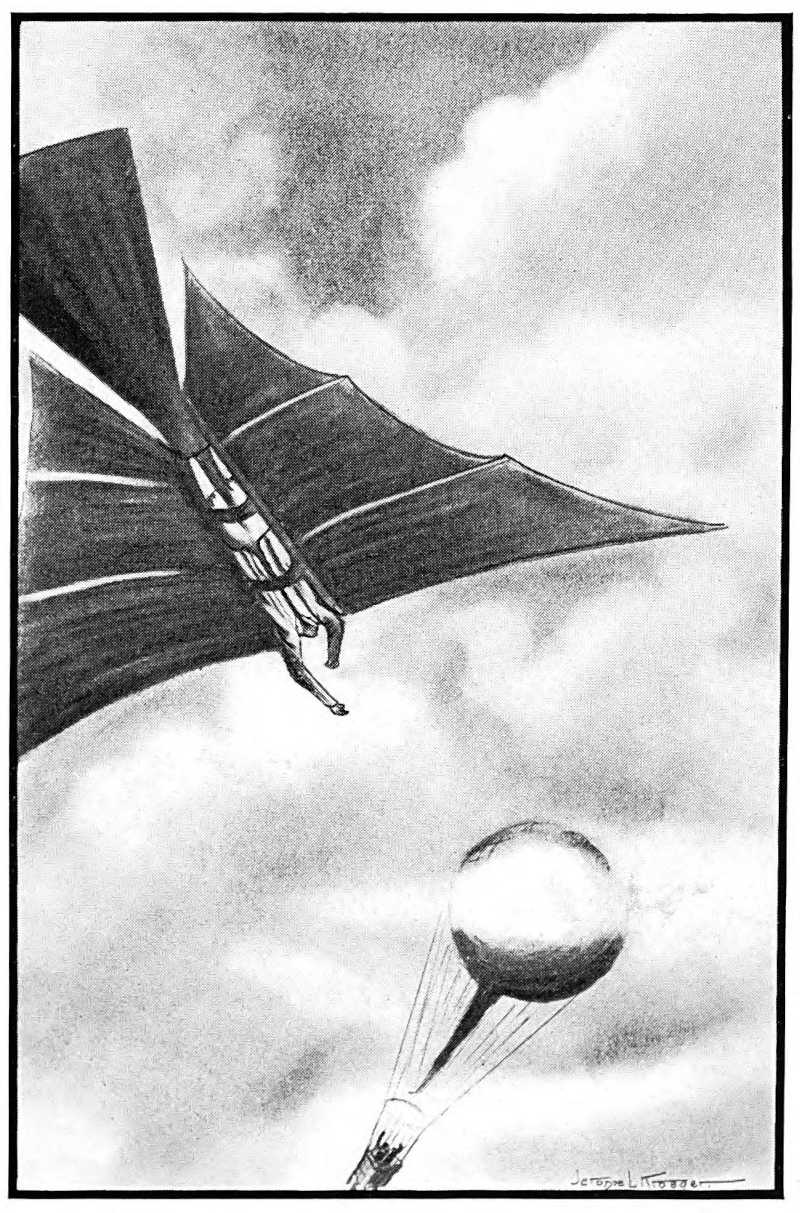
Nearer and nearer he came to the floating balloon.
[Pg 109]
“Please listen to me!” cried Joe, making a megaphone of his hands, for they were not needed in steering. “Do you see two cords hanging down from up above?”
“Yes! Yes! Two cords!” a man answered.
“Which shall I pull? The red one?” asked another.
“No! No!” shouted the young aviator. “If you do that you’ll be—you’ll go down too fast,” he hastily substituted. “Pull the white cord. Yank it once, then wait. Then pull it again. Don’t let out too much gas at once.”
Joe had not heard without understanding, what the balloon man had said about the cords which regulated the gas.
“Pull the white cord,” Joe cried again.
“All right,” answered the man.
While Joe flew, encased in the cage of his wings of steel, alongside the drifting balloon, the man reached up and took hold of the white cord. The boy watched him, almost afraid lest, in the excitement of the moment, some mistake be made.
But the man did just what he was told to do. He pulled the white cord, and at once the balloon began to fall.
“Not too much!” cried Joe. “A little at a time.”
“All right,” the man answered. “I understand.”
Again he let out some gas. The balloon sank lower.
[Pg 110]
“We’re saved! We’re rescued!” cried one of the women in the basket.
As the balloon began to descend Joe, in his wings of steel, guided himself toward the earth.
[Pg 111]
The two craft of the air came down together—Joe Strong looking like some weird bird, encased as he was in the cage of the Bat, the other in the more familiar shape of the ordinary balloon.
Joe had perfect control over his machine, and could steer himself wherever he wanted to go, now checking his descent by making the wings flap up and down, as a gull does when hovering over the water, again darting to one side or the other, following the drifting of the balloon, for the big gas bag had struck a lower stratum of air that was in more rapid motion than the upper region.
“Keep letting out the gas!” cried Joe to the man who held the white cord in his hand. “But watch yourself when you get nearer the earth.”
“And thank goodness we are getting back to earth!” fervently exclaimed one of the woman. “Oh! I thought I should never see it again. How did you ever get that machine, young man, to come to save us?”
“Oh, I use it in the circus,” Joe explained.
[Pg 112]
Talking could easily be carried on, as there was no sound from the balloon, and Joe’s motors, running at low speed, made only a slight humming sound. Besides, the upper air was a good carrier of voices.
Joe looked down at the crowd below. It was wildly excited, as was made evident by the running about and the pointing upward of the men, women and children. They were following the balloon, which was now drifting some distance away from the place where it had been tethered.
“They see us! They’re waving to us!” cried a young lady. “I can see my mother!”
“Yes, I told her I’d get you back safe,” said Joe, guessing that this was the daughter of the woman who had made such frantic appeals to him.
The young aviator kept watch of the man who had hold of the gas valve cord. Though the lad did not know much about balloons he had a natural mechanical sense, and his work in the air on his wings of steel had made him a good judge of distance and had given him the ability to calculate accurately the time needed for aerial evolutions. He noted how far the balloon was above the earth, and called to the man:
“Open it a little wider now, and hold it open until I tell you to let it close.”
“All right,” answered the man. He and the others seemed to place all their dependence on Joe.
[Pg 113]
There was a rush of gas from the opened valve, and the balloon went down so suddenly, and for such a distance, that the women screamed.
“You’re all right!” called Joe, who was following closely. “Close the valve!” he shouted to the man.
A release of the cord caused the valve to close of itself, for it was operated by a spring. The balloon stopped falling, but it was now so near the ground that many ready and eager hands could reach up and almost grasp the edge of the basket. It went down farther, and in another moment the thoroughly frightened, but now relieved, passengers were climbing out, with various expressions and exclamations.
“No more balloons for me!”
“Me either! I never want to see one.”
“I never thought we’d get back to earth again.”
“I almost fainted when I found we were going up.”
“Well, I’ve been in some tight places,” said one man, “but this was about the worst. No more for mine! Little old earth is good enough for me after this.”
“Same here!” a companion agreed.
The relatives and friends of the persons emerging from the basket of the balloon crowded around them, the women, more demonstrative than the men, hugging and kissing one another.
Then Joe, who had made a landing not far away [Pg 114]from the point where the balloon had come to earth, received his share of attention.
“There’s the young fellow who did it all. He saved us!” cried a woman.
“That’s what he did!” added the man who had pulled the valve cord. “He came up after us and told us just what to do to get down. Only for him one of us might have pulled the wrong cord, and we’d have fallen like a chunk of lead.”
A crowd gathered about Joe, some to inspect his curious wings of steel at close quarters, others to see the lad himself. Those whom he had rescued, as well as their friends, shook him warmly by the hand until his palm ached.
“Oh, it wasn’t much that I did,” he protested modestly, when showered with praises. “The balloon would have come down eventually, anyhow.”
“That’s what I tell them,” said the owner of the balloon. “They wouldn’t have been hurt.”
“Well, I’d as soon die by falling as of being frightened to death!” exclaimed one woman. “No more balloons for me!”
The balloonist and his assistant were now deflating the bag, and getting ready to pack it up. For it was evident that no more business could be done that day. The crowd was too frightened at what had happened, even though there had been, perhaps, no real danger to the occupants of the basket.
But this did not lessen the regard in which Joe [Pg 115]Strong was held. He had suddenly become a hero. He had done a clever feat. Even the balloon man admitted that.
“I never saw such a queer contraption of a flying machine,” he said to Joe. “What do you do with it?”
“Fly in the circus,” and Joe indicated the big white tent.
“He’s with the circus!” exclaimed one eager-faced boy.
“I’m goin’ to see him!” added another.
“S’m I!” a third chimed in.
“I made another good advertisement for the show, anyhow,” thought Joe with a smile.
The excitement began to quiet down now, though a big crowd was still gathered about the scene, discussing in all its phases what had just taken place. Joe had some of the circus men cart his machine back to the dynamo to be recharged. There was still a good supply of current available in the storage battery, but the young birdman had made a longer flight than he was in the habit of making, and he wanted to be sure he would have plenty of power for the exhibition in the circus tent.
A little later, this time for safety’s sake having donned his football helmet, Joe Strong was flying about in the big crowded tent. There was no counter attraction in the captive balloon, for the owner had taken it away, and many who had witnessed [Pg 116]the accident and Joe’s thrilling rescue, came to the show to view once more the Bat and its human occupant.
In addition to providing an extra advertisement for the circus, Joe gained a personal one for himself. For word of what he had done came to the ears of an enterprising newspaper reporter, who got a good story out of it. And as there happened to be in the crowd a camera enthusiast who snapped Joe as he was going to the rescue of those in the balloon, there appeared with the newspaper account a picture of the young aviator in flight. The story was published all over that section of the country, and Joe’s fame spread.
“Oh, I’m so glad you rescued those poor people, Joe,” said Helen, after the performance. “Of course, it was a great risk you took——”
“No risk at all!” Joe insisted. He declared, though few believed him, that his wings were perfectly safe.
“Well, anyhow,” Helen went on, not wishing to renew the old argument, “you have proved that your wings are useful as well as marvelous, Joe.”
“So I have!” he exclaimed. “I never thought of that. I may be able to make several of these machines and sell them. They might be useful for rescuing stranded aviators,” and he laughed at the idea of an aviator being “stranded” in mid-air.
There was such a crowd at the night performance [Pg 117]that many had to be turned away for lack of seating room. They came to see the birdman and his wings of steel, that was evident, and in order not to disappoint such a large number Joe decided on a little novelty. With the permission of Jim Tracy he flew around outside the tent, after finishing his act inside. He attached some small incandescent electric lights to his machine, illuminating them with current from his storage battery in the Bat, so that he was plainly visible as he flew over the heads of the overflow crowd from the circus tent. It was a free exhibition, and it pleased the people very much.
For a week or so after Joe’s sensational rescue of the balloon passengers the circus played to good business. They were touring through a populous and rich farming section, with a number of fair-sized cities scattered about, and large numbers came to the show.
Then, for some reason, business began to fall off again until the managers were almost in despair. For it takes a large quantity of money to run a circus, especially a train-show as contrasted to a wagon-show. In the latter the whole outfit is hauled from place to place by horse and wagon, and transportation charges are low.
But railroad charges are high, and with the other necessary charges accumulating from day to day it was needful for the show to take in a large sum [Pg 118]every twenty-four hours to keep things running. Then, too, several of the performers, like Joe, were paid large salaries.
“Well, we’ve had a pretty lean week,” remarked Jim Tracy to Joe one Saturday night as the show closed, to remain over Sunday in the town where it had played. “A pretty lean week, and if we have many more—well, I guess I’d better not say what will happen.
“But I’m counting on Rockport to make good for us. We stay there three days, and it’s the center of a big and prosperous section. We ought to take in a lot of money there.”
“I hope we do,” said Joe.
“We’ve just got to!” the ring-master exclaimed.
But alas for their hopes. When Rockport was reached and the circus went out to the lots that had been hired, Jim Tracy saw a collection of newly erected wooden buildings not far away, evidently of temporary construction.
“What’s that?” Jim asked the advance agent. “Has another circus gotten in ahead of us?”
“No, it’s about as bad though. That’s an aviation meet, and they start giving flying exhibitions to-day!”
[Pg 119]
“What’s that?” asked Joe Strong, coming up in time to hear the last remark. “What’s going on?”
“An aviation meet,” repeated the advance agent, whose business it is to go ahead and arrange matters for the coming circus. “They’re going to run counter to us. I didn’t know, until the last minute, what it was, or I’d have wired you not to come. But now the show is here——”
“We’ll have to stay,” said Jim Tracy gloomily. “It’s a long jump to our next stop, and we need money to go on. We’ve got to play here if only to half crowds.”
“And it’s likely to be that,” observed the advance agent. “Aeroplanes are new out in this section, and the people are crazy to see them.”
“An aviation meet, eh?” mused Joe. “Well, I guess it is a mighty interesting thing, but I hope the people will patronize our circus.”
“That remains to be seen,” the advance agent said. “They’re going to have all sorts of attractions—races; [Pg 120]the dropping of chalk bombs; a war game, in which the aviators will endeavor to locate hidden bodies of troops; and things of that sort. We sure are up against it hard!”
Joe began to think so himself. Though it was early and there was none of the “birdmen” in sight, there was a big crowd around the hangars, as the wooden buildings are called which house the biplanes and monoplanes.
“If they crowd over there now just on the chance of having a glimpse at an aviator, what will they do when the real show starts?” mused Joe. “Why, we’re almost deserted!”
This was true. The usual crowd that always came to see the circus tents put up was but poorly represented, and if this was a forecast of what would happen in the afternoon and evening, when the show would be under way, it meant something like financial disaster.
One big feature in favor of the aviation meet was that it was open and free to every one. Of course, an admission fee was charged to the grounds, which was the only place where a close view could be had of the machines and the aviators. But once the birdmen arose in the air, they were visible for a long distance the country round. And what small boy, especially, would pay fifty cents, or even a quarter, to go to a circus, when he could see the aeroplanes for nothing? Very few, thought Joe.
[Pg 121]
But there was, as the ring-master said, only one thing to do, and that was to go on with the circus and trust to luck to draw part of the crowd away from the aviation meet. The latter show was first on the ground, but the circus had been billed long in advance, and it was fair enough to both sides.
So while the tents were being put up, and the animal exhibit being put into readiness, Joe and Helen strolled over toward the aviation grounds.
“Be back in time for the parade, Joe!” called the ring-master after him. “If ever we needed you to fly from the back of Rajah, we need you to-day. We’ve got to do all we can to arouse interest in our show.”
“Oh, I’ll be on hand!” Joe promised.
He wanted very much to look at some of the aeroplanes, for he had some new ideas regarding the Bat, and he wanted to see if they were feasible. He thought he could get additional ideas by seeing the monoplanes and biplanes.
“And do men actually fly in them?” asked Helen, when she and Joe had gone in through the gate, Joe buying the tickets.
“Yes,” he answered. “They really glide through the air, but on a different principle from that on which my machine works. They get their power from wooden propellers, revolved by a gasoline engine. The propellers in the air act just as do the propellers of a boat in the water, only the air propellers [Pg 122]must move much faster, as water is denser than air. In my machine I rise just as a bird does, by successive flappings of the wings of steel against the air. Once I am up I can glide like a bird, and drift, as the aeroplanes sometimes drift, on a downward slant. Volplaning, they call it.”
“How interesting!” exclaimed Helen.
“Do you like it?” asked Joe. “If you do, I may build an aeroplane some day and take you for a ride above the clouds.”
“Thank you, no!” exclaimed Helen quickly. “I mean it is interesting to look at and hear about, but I don’t want to go up. Seeing that balloon get loose was enough for me!”
“Oh, that was nothing!” laughed Joe.
It was too early for the regular exhibition of the aeroplane meet, but mechanics were busy over machines, and, in some cases, the aviators themselves were on hand, looking after their apparatus, getting ready for the afternoon flight. The flights would take place about the time the circus started, and would be a big counter attraction.
Joe pointed out to Helen the difference between the biplanes and monoplanes. The latter have but one expanse of surface, composed of specially prepared cloth stretched over a light framework. Biplanes, as the name indicates, have two surfaces, one above the other. The biplanes are more powerful and safer, but the monoplanes, or “one-planes,” [Pg 123]are swifter and more easily managed, though rather dangerous.
Joe wanted a chance to talk to some of the aviators, but he did not get it, as the time of the parade was drawing near and he had to do his part, rising in his wings of steel from the back of the big elephant, Rajah. That was counted on to attract attention and draw crowds out to the tents.
If the throngs in the streets that watched the circus procession and applauded Joe’s flight were any indication, the circus might hope to do a good business. For Rockport was a large city, and all about it were thriving towns which seemed to have poured out much of their population to witness one or the other of the shows.
There was a big, cheering and apparently eager crowd in the streets to witness the parade, and the hopes of the circus folk rose somewhat on the return to the grounds. But when the afternoon came, and the ticket sellers and ticket takers were ready and waiting, they were not overwhelmed with a rush. Of course, many persons came to the circus, but more went to the aviation meet, or stood outside the enclosure, ready to watch the aviators fly.
“I was afraid of this,” said Jim Tracy, with a gesture of despair, as he looked in the half-filled tent. “We can’t pull against the aeroplanes.”
“Well, we can all do our best!” exclaimed Helen. [Pg 124]“We’ll show the crowd we have in here what a fine show we can give!”
“That’s the way to talk!” exclaimed Bill Watson, the veteran clown. “Helen, you’ve struck the right idea. We’ll give a bang-up, smashing good show, and it will be talked about. Not that we don’t always do our best, but this time we must do our bestest!” and he smiled at his new word.
“Well, that will help some,” conceded Jim Tracy, “and I’m sure obliged to you all for the spirit you show. Do the best you can, and if we fail, we’ll go down with flying colors anyhow. Start the music!”
With a blare of trumpets the grand entry was under way, and then began a game fight against odds on the part of the circus folk. For the aviation meet was in full progress, and during the pauses in the performance in the main tent there could be heard the staccato explosions of the engines of the aircraft, for some of them flew over the circus grounds.
As Helen had proposed, they all did their best. The clowns worked hard to get laughs, and the acrobats did their most dangerous tricks to win applause.
In his flying exhibition Joe went around the tent more times than usual, to give the people their money’s worth, as he said afterward. And when the time came for him and Benny to go into the [Pg 125]tank (Joe doing the countryman turn as before) he proposed to the human fish that they try for a record on holding their breath under water.
Benny agreed, and Jim Tracy made the announcement. This aroused much interest, and there were eager watchers as Benny and Joe deflated their lungs, to fill them to their capacity with fresh air.
They made a good record, too, better than usual, though Joe, on certain occasions, had beaten it. The crowd applauded, and then came some of Joe’s sleight-of-hand tricks under water, while Lizzie, the trained seal, added to the interest of the tank act.
“Well, they can’t say but that we gave them a good show,” said Jim Tracy, as the crowd filed out. “Now if they’ll only spread the report around town, it may bring a big crowd out to-night. There’s one consolation, moreover, the aviation meet will be closed at night.”
“Oh, no, it won’t,” said Mr. Sampson gloomily. “I’ve been making inquiries, and they’re going to give a night show too. The machines are to fly in the air, illuminated with electric lights, and there will probably be as big a crowd over there as there was this afternoon. We’ve got to get the people here on the merits of our show, or else quit the game.”
Jim Tracy shrugged his shoulders. He did not know what to say.
[Pg 126]
Joe and Helen, after the afternoon performance, had gone over to the aviation grounds again, and the lad met one of the aviators, with whom he had a long talk, learning some things he did not know before. The aviator also told Joe what the programme for the next day was going to be.
What Mr. Sampson feared happened that night. Or rather, it did not happen. There was even a smaller crowd in the circus tents than in the afternoon, but the performers did not relax their efforts to amuse and thrill the audience.
“We’ve just got to do something!” the ring-master exclaimed, when a report came in that a big crowd was over at the aviation grounds.
“What can we do?” asked Mr. Sampson.
“Who has an idea?” asked the ring-master. “Don’t all speak at once,” he added, with a grim smile.
“I have a plan,” said Joe. “It may work, and again it may not. But I’m willing to try it.”
“Good for you!” cried Jim Tracy. “Let’s hear your plan, Joe.”
[Pg 127]
Joe Strong looked into the faces of those gathered about him. There were the ring-master; Bill Watson, the veteran clown, who owned a small interest in the show; and Mr. Sampson; besides the other partners. On each face was anxiety, for they well knew what failure meant. And if the tents were not filled failure might result, on account of so long a run of bad luck.
“Well, this is what I thought of,” began Joe. “There is to be a free-for-all race to-morrow—a sort of handicap affair, and I was thinking I could enter myself and the Bat. We could let it be known that I was from the circus, and, even if I didn’t win the prize, it would advertise the show so that we might get a big crowd in. The race takes place in the morning, so it won’t interfere with my performance.”
“But do you know anything about running an aeroplane, Joe?” asked Mr. Sampson.
“I don’t intend to run one of them. I’ll use my Bat.”
[Pg 128]
“Is it fast enough?” asked Jim Tracy. “Some of those aeroplanes are pretty speedy, I understand.”
“I can make the Bat go fast when I want to,” Joe replied. “I don’t dare let it out in the tent or I might burst through the side. But of course I can’t compete with their speediest machines. However, this is to be a handicap affair—that is, the fast machines will have to let the slower ones get off first on a time allowance. I ought to get a pretty big allowance as I don’t rate very high in power as compared to the others. So I think I have a good chance for a prize.”
“Well, maybe you have,” conceded Jim Tracy. “It’s very good of you to offer, anyhow.”
“Well, why shouldn’t I? I want to see the circus make money as much as the rest of you. My living depends on it, especially since I don’t seem to be getting any more money from England.”
“Is the game up over there?” asked the veteran clown.
“So it seems,” answered Joe. “Well, what do you say? Shall I try in the prize race?”
“By all means!” exclaimed Mr. Sampson. “Get your entry in early, and do the best you can. I’ll have some dodgers printed advertising the fact that one of our circus performers is going to race in the oddest air machine ever invented. Even if you don’t win the race you may create enough interest [Pg 129]to bring bigger crowds in here to see you. Go to it, Joe, as the boys say!”
“I will!” promised the young performer. “I’ll give my Bat a good overhauling to-night to have it ready for to-morrow morning, and I’ll go over now and make my entry.”
Joe had no difficulty in getting himself and his machine entered in the handicap prize race, which was for a gold cup and a sum of money, there being no amateur rules to govern air-flying. When the lad described and named his machine the official making out the entry blank looked up in surprise.
“You don’t expect to stand any chance in that, do you?” he asked, smiling good-naturedly.
“Well, yes,” said Joe. “It is a peculiar machine, but I think I can make good if I get the right kind of handicap.”
“We will be perfectly fair, of course, and from what you tell me of the power of your storage battery you will get a good time allowance. I shall have to see your machine, first, however.”
“I’ll have it over in the morning,” promised Joe. Then he went back to his own quarters in the circus tent to work over the Bat. He had an extra set of gear wheels and torsion rods which gave greater speed than the ones he had been using, and these he put in, with the help of some of the circus mechanics. Then the storage battery was charged to [Pg 130]its limit, and the boy himself carefully oiled every bearing.
“Now we’ll see what happens,” he said, as he went to bed at a late hour to get some much-needed rest.
There was considerable activity the next day both on the circus grounds and in the aviation enclosure. For word of what Joe intended to attempt had gone around, and there was much interest manifested. The aviators were “grooming” their machines in readiness for the race, and on all sides could be heard the popping of the powerful engines.
The Bat was taken over for the official handicap test, and to Joe’s delight he was given the longest time allowance of any of the racers.
This meant that Joe would be allowed to start off ahead of any of the others, who would follow at indicated intervals. And this was perfectly fair, just as it is fair to allow a small boy to start ahead of a big boy in a race. It evened matters up.
A great crowd was on hand early in the morning, for the aviation meet had been well advertised, and the race was a special attraction.
“It’s lucky they had it in the morning instead of the afternoon,” remarked Jim Tracy, as he watched the throngs surging around the hangars and scattering over the grounds, “else we wouldn’t have a handful of people in our tent. But if Joe brings home the prize, and even if he doesn’t, we may [Pg 131]get enough advertising out of it to pull us up even.”
“I hope so,” said Joe.
He was getting ready for the race, and to make it more spectacular he had donned the white shimmering suit he wore when riding his motor-cycle across the high wire. This showed him off to advantage inside the framework where he had to take his place to operate and steer his queer machine.
The course was three times around the aviation grounds, the termination being in front of the grandstand. Already some of the aviators were practising, flying around to “tune up” their engines. Joe decided he would not do this, as his power in the storage battery was a constantly lessening one, and he could not afford to waste any of the current. He knew pretty well what the Bat could do, and his motive power, unlike that of the others, was positive and certain as long as a volt or ampere remained in the battery. A gasoline engine is so complicated that it needs constant attention and care.
Larger and larger crowds assembled to witness the race, and while the grandstand, as well as the less expensive seats, was well filled there was also a vast throng outside the grounds.
“If we only had them in our tent!” exclaimed Jim Tracy.
“Maybe we’ll get them there this afternoon,” said Joe.
[Pg 132]
It was almost time for the race to begin. Joe’s machine was taken to the starting line and he got inside. The officials were waiting, watches in hand.
“Go!” came the sudden order, and Joe turned on the power.
Once again the big wings vibrated up and down, fanning the air with ever-increasing power. Then, amid a cry from the crowd, the Bat rose quickly upward and shot off around the course.
Joe decided to go upward until he found a favorable current of air. He wanted a place where the wind did not blow at all, if such were possible to find, for, as the course was circular, if he got into a wind stratum he would be helped half way around, and then hindered as much in the other half.
At about a thousand feet elevation the boy found what he wanted, and then he set off on a straight course, having risen at an angle. He was going quite fast, but still had some power in reserve.
A noise behind him, like the firing of a dozen rifles, told Joe his first competitor was coming after him, but he could not turn around to look back.
“I’ve just got to keep on flying and trust to luck,” he told himself. For his machine was so built that only by a great effort could he turn around in it. “The next one I make will have more room,” Joe decided.
On and on the lad went. He could hear the explosions of more aircraft engines now.
[Pg 133]
“I guess the last of ’em must be off now,” Joe reflected. “They are the speediest of the lot. Still they may have an accident, and while I don’t wish any one bad luck I do hope I win this race.”
As may be guessed, accidents are very likely to happen to aeroplanes, though the machines are much safer and more reliable than in former years. The accident of which Joe thought was the stoppage of the engine. Once this occurs, it is necessary for the aviator to descend to the ground and start again. He glides, or volplanes, to the earth, with very little risk, and has a mechanician whirl his propellers until the stalled engine starts again.
There are very few aeroplanes with self-starters that can be put in operation from the aviator’s seat. The makers are coming to this very necessary feature, however.
Joe Strong knew that if some of the speediest, and therefore largest and most complicated, machines should have a stalled engine, his chances would be improved. It was all in the sporting chance. An accident might happen to the wings of steel as well.
Once around the course went Joe, the others following him. Down below, the big crowd, including many circus folk, were cheering like mad, for it was a thrilling and exciting sight.
“Well, I’m ahead yet,” said the young circus performer to himself, as he glanced out of the side of his cage and saw none of the others in line with [Pg 134]him. “If I can keep it up for two rounds more I’ll be all right. But the worst is yet to come.”
Half way on the second round Joe heard a noise gradually drawing nearer to him. Then he had a glimpse of an aeroplane that was overtaking him.
“I guess it’s all up,” the boy mused. Still he was doing his best, and he had the satisfaction of knowing that either way it would be a big drawing card for the circus.
Slowly the other air machine nosed its way ahead of Joe. There were other machines behind the circus airman and his nearest competitor, but they did not seem to be able to cut down Joe’s lead sufficiently to pass him.
“Well, now comes the test,” the lad said grimly, as he swung into the “home stretch.” He gradually turned on the reserve power he had been saving, and saw that he was creeping slowly up. Then to his joy, though with it was mingled a feeling of regret for the other man, he saw that the aeroplane was losing speed. The explosions did not come so regularly.
“His engine is missing!” thought Joe. “I’ve got a chance!”
There was a click as he threw the switch over as far as it would go and shot forward at increased speed. As he did this, he noted the lack of sound from the rival machine and knew that the engine [Pg 135]had gone dead. The aviator began to volplane down.
Then, amid the wild cheers of the crowd, Joe flew on and on, until he shot over the finish line—a winner!
[Pg 136]
“Joe Strong wins!”
It was the voice of the race-judge announcing that fact—a fact which every spectator could see for himself, for the aviator in the monoplane which had come so near to beating our hero had come to earth some distance from the finish line. And those behind Joe did not cross until after he had done so.
“Well, I did the trick,” thought Joe, as he came down to the ground, and released himself from the inner cage. “But it was a close squeak. Now we’ll see what good it does the circus.”
The fact that Joe had won because of the disablement of one of his competitors’ machines did not in the least detract from his victory. Every race, or contest, is won either through the superiority of one man or machine over another, or because of some failure, slip or weakness on the part of the loser.
“Great work, Joe! Great work!” cried Benny Turton, rushing up to shake hands with his chum.
[Pg 137]
“That’s just what it was!” chimed in Jim Tracy.
Others were crowding around Joe, endeavoring to shake his hand. Most of them were strangers to him, but among them were some of his circus friends and the other aviators.
“Allow me to congratulate you!” exclaimed the judge of the race, and he, also, shook hands with the boy. “Your time for the three rounds of the course was twenty-seven minutes, eight and three-fifth seconds, which is very good, considering the type of machine you used.”
“Thank you,” responded Joe. “I don’t recommend my machine for speed. I got it up for the novelty of it, as novelty is what is wanted in a circus.”
“I see,” remarked the judge. “Now if you will come over to the stand I’ll give you the cup and prize money.”
After giving some of the circus attendants instructions about caring for the Bat, Joe Strong made his way through the throng. He would soon have to use the wings of steel in the circus, and the batteries needed recharging.
“Well, you beat me fairly and squarely, friend,” said the man who had been forced to come down in his monoplane.
“I’m glad you think so,” the circus lad responded. “I’m sorry your engine went back on you. Only for that you’d have come in first.”
[Pg 138]
“Oh, it’s all in the game. I’ll beat you next time.”
“There isn’t going to be any next time for me—not in the style of air craft I’ve been using,” said our hero. “It isn’t built for racing, I can see that. I did it for the advertisement it would give our show.”
“Well, it’s a good one. I’m coming in myself to see you to-night, for I don’t fly after dark. I don’t care for it.”
“I’ll be glad to see you,” responded Joe.
A little later, with the prize money and cup in his possession, Joe and his circus friends went back to the circus grounds, there being no parade that day. The prize cup was put on exhibition, and the press agent of the show saw to it that a good notice of Joe’s success was sent to the papers.
“It’s the best advertisement of the show we’ve had in a long while,” the press agent said, clapping the winner of the air race on the back. “I wish you could do something like that every day.”
“That would be a little too much,” Joe replied. “But I’ll do the best I can.”
Joe’s feat in winning the aviation prize had just the effect he and the others of the circus had hoped for. It brought crowds to the show that afternoon, so that every seat was filled, and hundreds had to be turned away. And this in spite of the fact that there [Pg 139]was an exhibition on the aviation grounds at the same time.
“I don’t wish them any bad luck!” exclaimed Jim Tracy, “but that is what I like to see,” and he motioned toward the crowd in the tent, and nodded over toward the place where the aviators were flying before a very small attendance. “And turning them away is a good sign. They’ll come back to-night—and others too I hope.”
This hope was also realized, for another record-breaking crowd assembled for the evening performance.
“We’ll make up what we lost by staying here another day,” said Mr. Sampson. “Things begin to look brighter.”
Every one felt much better. Perhaps Joe best of all, for it had been permitted him to bring about the good luck.
The fact seemed to be that the public wanted to see a person in an air craft at close range, which they could do in Joe’s case as he flew slowly over their heads.
A biplane or monoplane moves so swiftly that it is soon beyond the range of the spectators, and only appears like a speck in the sky. But Joe, though he could go high when he wished, remained near the earth, thus enabling every one in the circus tents to see how his machine was operated and how he steered it. This, perhaps, was the reason why such [Pg 140]crowds came to the circus after Joe had advertised himself by winning the aviation prize.
The third day of the circus in Rockport was also marked by a record-breaking attendance, and there was jubilation among the partners. They would have stayed another two days, which would have marked the end of the aviation meet, and which would have insured them more patrons, but they had other dates to fill, so they moved on.
Not, however, before several of the aviators had called on Joe to examine more closely the Bat. All of them agreed that it was a clever piece of work, but they said, with Joe, that for quick work kept up for a long distance, it was not to be compared with a monoplane or a biplane.
“Its chief value,” said the man who had so nearly beaten Joe, “is its smallness. It would be great in war, I think, for an army could carry several of these small machines, and a man could go up, take an observation, and come back with much less trouble than in one of the big machines we have.”
“Well, I don’t fancy going to war,” laughed Joe.
Once more the big show moved on, and the “hoo-doo” which seemed to have fallen on the finances appeared to be broken. For after the performances in Rockport the circus played to good business in several cities in succession. Joe, Benny Turton, Helen, with her horse, Rosebud, Bill Watson, and [Pg 141]one or two others were the “stars” of the circus, and its chief attractions.
Joe, as may well be imagined, was almost a show in himself. He rode his motor-cycle across the high wire, giving an exhibition in marksmanship that was very difficult, for he had to steer his machine with his knees as he shot the pistols at the glass balls or toy balloons. Then, having thrilled the crowds in that fashion, he got inside the Bat and circled about the tent. And once again in this part of his work Joe introduced something new.
Helen saw him outside his dressing room one day, inside the main dressing tent, juggling with a number of red balls.
“What are you doing, Joe?” she asked. “You’re not going back to your sleight-of-hand work, are you?”
“Not exactly,” he answered. “But I don’t want to get rusty, and I’m practising so I can do this when I’m flying in the Bat. I think it will make the act a little livelier.”
“I think it would if you dropped them on the heads of persons in the audience,” Helen said with a laugh.
“That’s why I’m practising—so I won’t drop them,” Joe replied. “Anyhow, they’re so light they wouldn’t hurt much, but I don’t want to do any ragged juggling like that. Hence the practice,” and he went on tossing the balls up in the air, skillfully [Pg 142]catching them, sometimes using one hand and sometimes two.
After considerable practice, the youth felt that he had gotten back enough of his former skill to try juggling while he was flying. He did not succeed very well when he first practised with the machine in an empty tent. But he kept at it and at last announced he was ready to put on a new act.
“Good!” exclaimed the ring-master. “Go to it, Joe!”
Joe did. And that day, while flying about the tent over the heads of the audience, the young airman tossed up the red balls and caught them, keeping them circulating in the air.
It was simple enough in itself, but when it is remembered that Joe had to give considerable attention to the steering of his machine—up and down as well as sideways—and look after the controlling of the motors, varying the vibration of the wings in making turns, and do this while using his hands for juggling, it will be seen that it was not quite easy. The young experimenter had been obliged to make a little different arrangement in the mechanism to enable him to use his hands freely.
Joe’s variation of his flying act acted as a new stimulus to the applause of the crowd, and he received so many “hands,” as this sort of appreciation is called, that some of the other performers were [Pg 143]more jealous of him than ever. But that was only natural.
In addition to all this Joe did an act with Benny in the tank, using the same plan that he had found so laughable—that of the rustic pretending to catch the seal and falling in. This never failed to bring forth a laugh.
Joe’s fame spread, especially after his winning of the aviation prize, and one day he received a letter from a rival circus, making him an offer of a high salary if he would transfer his work to their tents. The offer was a good one, the salary being much larger than the one Joe was then getting.
“Well, I would like the extra money,” he mused, “especially as I don’t seem to be going to get mine from England. But I must play square with my friends. I can’t desert them now.”
Joe was going to say nothing of the offer to Jim Tracy or Mr. Sampson, for he did not think they could afford to increase his salary, and he did not want to cause them worry, as they had been very good to him.
But he spoke of the matter to Helen, and, she, saying nothing to Joe about it, privately informed the ring-master.
“Joe is entitled to get all he can,” she said, “but he doesn’t want to tell you about the offer for fear you will think he is trying to force you to raise his salary.”
[Pg 144]
“I’m glad you told me,” said Jim Tracy. “Your idea is right—a performer is entitled to all he can get. Nor do I blame the other circus for trying to get Joe. But we’re not going to let him go. I’ll have a talk with him.”
Joe was surprised when the ring-master spoke of the letter.
“I wasn’t going to say anything about it,” said Joe.
“I know you weren’t, and I appreciate your motive. But I found out. And I want to say, Joe, that I have taken up the matter with the other owners, and we have decided not to raise your salary.”
“Oh, well, I didn’t expect you to,” and Joe wondered at the smile on Jim’s face.
“No, we’re not going to raise your salary, but we’re going to do something better. We are going to give you an interest in the show, and if we keep on doing as good business as we have the last few weeks, and if you continue to draw, as I know you will, you’ll have a larger salary than even the other people offered.”
Joe was so surprised that he hardly knew what to say, but he managed to stammer his thanks. A few days later legal steps were taken that made him one of the Sampson Brothers’ partners.
“Oh, Joe, I’m so glad!” Helen exclaimed, her eyes shining.
[Pg 145]
“So am I!” he answered. “Was it you who told about the offer from the other circus?”
“How’d you guess?” she laughed, and blushed.
“It wasn’t very hard, seeing that you were the only one I told,” Joe replied.
It was about a week after this that, as Joe was resting after the afternoon performance, a messenger came to him, saying:
“There’s an elderly man outside asking for you. Shall I show him in?”
“What’s his name?”
“He said he didn’t want to give it except to you.”
Joe thought for a moment.
“It may be some word from my English estate,” he mused. “I’ll see the man,” he told the messenger.
An aged man, with gray hair, a bushy beard, and queer, sharp, darting eyes came shuffling in.
“Are you the young fellow who made the flying machine, and sails in it?” he asked. The lad thought he had to deal with a curiosity-seeker and was sorry he had let him in.
“Yes, I made the Bat,” Joe answered. “I’m sorry that I have no time now to——”
“Hush!” exclaimed the old man. “Can any one hear what we say? It must be kept secret. Listen! I am an inventor, and I have discovered something that will be of great value if put on your apparatus. May I tell you about it?”
[Pg 146]
Joe at first thought he had to deal with a dangerous crank, for the old man had a queer manner. The circus performer was about to call for some of the sturdy canvasmen to put him out, but the visitor seemed to read what was in the lad’s mind, for he quickly said:
“Now don’t be rash, young man. I came here at great personal inconvenience to do you a favor, so don’t turn me away. I am not asking for any of your money. I have more than I need, which may seem strange when I tell you I am an inventor.”
“Yes, inventors don’t usually become millionaires,” said Joe, who decided to listen to what the man had to say.
“I did not make my fortune by an invention,” the man went on. “It was left to me, and I have spent many thousands in perfecting several machines. I am much interested in aviation.”
The man’s language was good, and he talked rationally. And as Joe looked more closely at him he [Pg 147]saw that his clothing was of fine quality, though carelessly worn. The man’s cuffs showed diamond-studded links, and his watch chain was of heavy gold.
“Perhaps I misjudged him,” thought the youth. “He may be rich and eccentric, and may have discovered something worth while. If he could tell me some way of getting a more powerful storage battery and, at the same time, of less weight, it might be a good thing for the Bat. I’ll hear what he has to say.”
“I don’t want any one to overhear what we say,” the visitor went on.
“They won’t,” said Joe. “But, if you like, you can come into my dressing room.”
“I’d rather, if you will, have you come to my shop,” the inventor replied. “I have fitted up a workroom in my house, and I do my tinkering there. It’s safer, too, for several persons have tried to steal my inventions. But now I keep them locked up. Will you come? It isn’t far.”
“What is the nature of your invention that applies to my flying machine?” Joe asked. “And do you think you can tell me how to improve it?”
“I’m sure I can,” said the man eagerly. “I have watched you fly. I was in Rockport at the aviation meet.”
“Oh, then you know something of heavier-than-air machines?” asked Joe.
[Pg 148]
“I do. And I have read much about you. I was interested from the first in your Bat, as you call it, and I made up my mind that I would see you as soon as I could. Business called me away from Rockport before I could speak to you, but I knew the circus was coming here, so I waited. I just witnessed your flight in the tent.”
Joe was more and more favorably impressed by the man, and he decided to humor him to the extent of going to his house with him.
“Do you know anything about storage batteries and small motors?” asked Joe. “I depend on them in my machine, Mr.——?”
He paused questioningly.
“Clark is my name—Samuel Clark,” the man said. “I have lived here all my life. I have made a special study of storage battery motors. That is what I want to talk to you about, and show you.”
This suited Joe, for he had a hazy plan for the next year of building a larger flying machine that would carry two. He hoped to induce Helen to fly with him, for that would make a big hit, he was sure.
“All right, Mr. Clark,” Joe said, “I’ll come with you. But I have to be back here for the evening performance.”
“Oh, yes, I understand that,” was the answer. “My place is not far away. I am sorry I haven’t an [Pg 149]automobile or a carriage, but I am rather old-fashioned, and prefer to walk.”
“I like walking myself,” Joe admitted. “But with my motor-cycle and my flying machine I don’t get much of it, so I’ll be glad of a little exercise with you.”
Joe and the inventor left the circus grounds, and on the way to Mr. Clark’s house the man talked intelligently about electric energy as embodied in motors and storage batteries.
“I guess maybe he may have invented something worth while,” mused Joe, “and he’s eccentric enough not to try to market it. If I can get a battery powerful enough to make a double machine go up, it may be a great thing.”
One thing struck Joe as being rather queer, but he did not give it much thought until afterward, when it was almost too late: So many persons who passed him and Mr. Clark on the street looked at the latter in a very odd way. Several times persons seemed to be talking about Mr. Clark as he passed them. Joe ascertained this by looking back, and twice he saw men pointing or nodding their heads in the direction of his companion.
“I guess it’s because he’s a bit odd, that’s all,” thought Joe.
And another odd thing was that though Mr. Clark said he had lived in the place all his life he neither bowed nor spoke to any one he passed.
[Pg 150]
“Another eccentricity,” decided the lad. He was so taken up with his new idea of building a bigger machine, and flying about the circus tent with Helen, that he gave no more heed to the two queer things he had noticed.
“You have seen my machine work,” remarked Joe, to his companion. “Do you think it possible to make one twice as large and that would carry two persons, and yet have the storage battery not twice as heavy in proportion?”
“I’m sure it can be done!” exclaimed Mr. Clark eagerly. “In fact, my battery now, though not perfected, would do that work. But I am going to get it even lighter yet, and I am working on another point that will be more valuable. It is the doing away with the sulphuric acid in storage batteries. I am going to make a dry one.”
“That would be an invention!” cried Joe, who could see the value in that possibility. “That would be just the thing for submarines. For now there is danger that the storage battery may become flooded with sea water. Then chlorine gas is generated, and that is fatal to the crew.”
“My idea exactly!” exclaimed the inventor, and then he plunged into a mass of technical details, rather beyond Joe.
“Here’s my place,” said the aged man some time later. The walk had been a long one, but Joe had enjoyed the exercise.
[Pg 151]
They had come to a less thickly settled part of the city. Mr. Clark turned into a patch that led toward a large but shabby and gloomy-looking house. All around it was a high hedge, unkempt and untrimmed. The gate was half off the hinges, and the whole place spelled decay. For an instant Joe held back.
“After all, wasn’t my first impression right and isn’t this man a dangerous crank?” Joe asked himself. “I wonder if I hadn’t better pull out of this right now.”
“I don’t waste money keeping my place up,” said the old man. “This is the old homestead, but it is going to be sold soon to a development company which wants the land. The house is to be torn down, so it isn’t worth while to spend money on it. It isn’t so bad inside.”
So that accounted for the looks. Joe kept on. With a key which squeaked rustily in the lock the old man opened the front door. The place smelled musty, as though it was seldom opened, and there did not seem to be any one but themselves in the house. The footfalls of Joe and his companion echoed through the silent rooms.
“I live alone,” explained the man, in answer to Joe’s look of inquiry. “I don’t wish to be bothered with people, and I have no near relatives. I can work better alone.” This feeling was natural enough in an inventor, the lad felt.
[Pg 152]
“Now for my workshop,” the old man said. “I’ll let you judge of some of my inventions. Come up this way. And look out, for some of the steps have rotted away.”
He started toward a big staircase and the boy followed. One did need to mind one’s step, for there were big holes in the stairs, and some, Joe thought, seemed to have been made with an axe, as if vandals had started to demolish the old building.
“Right in here,” went on Mr. Clark, unlocking the door of a room on the second floor.
He stood aside to let Joe enter first, and our hero unthinkingly did so. He saw before him a queer mass of machinery, some of which he recognized as electrical. In one corner was a big storage battery, but at a glance Joe knew it was too large for his machine. And in another corner was something that rather surprised him.
It was a flying machine, not unlike his own in so far as it had metal wings. But the boy was sure it would never go up. It was too big and clumsy.
He turned to speak to the inventor, and ask about the new light-weight storage battery, when he saw the door being pulled shut, with Mr. Clark on the other side. There was a malicious grin on the old man’s face, and a queer glint in his eyes. He seemed to have changed in an instant.
[Pg 153]
Joe sprang forward to prevent the door’s closing—for he at once suspected a trap—but he was too late. The lock clicked, and with a laugh that had in it the sound of madness the old man cried:
“Now I’ve got you just where I want you! You won’t steal any more of my inventions!”
[Pg 154]
Joe Strong was so startled, astonished and altogether taken by surprise that he did not feel capable of moving for several seconds. Then he threw himself against the door, but it opened inward, and he only bruised himself.
“Ha-ha!” laughed the old man on the other side. “You can’t get out that way. I’ll teach you to take my invention and go flying all over the country with it. I’ll teach you!”
“Say, are you crazy?” cried Joe, a suspicion that such was the case entering his mind.
“Crazy? Me? No, I’m not crazy!” was the quick retort. “But most of the other folks in the world are. You are crazy to try to steal my invention and think I would not find it out. Now you’ll never do it again. You’ll die in there.”
Joe knew that he must be cool and keep his head. He had evidently been made a prisoner by a madman, and perhaps by humoring him he could get out without using force. He looked around the room and saw it contained only one window, high up, and that was small and guarded by iron bars.
[Pg 155]
“I think you are making a mistake, Mr. Clark,” said Joe as calmly as he could. “I never stole any of your inventions. In fact I never saw you before to-day.”
“That makes no difference,” was the retort. “You stole my invention just the same. Look in that corner and you’ll see a flying machine like yours. I made it years ago, and you found out about it and made one like it. You have secured a lot of money by exhibiting yourself in a machine made from my stolen invention, but this is the end. I have you where I want you now.”
That was evident enough. But it was a place Joe did not want to be in, even though the crazy inventor wanted him there.
“That was the meaning of all those looks on the part of persons in the street,” thought Joe. “They knew he was crazy and they were probably wondering why he was allowed to be at liberty. I wish I had not come here.”
But it was too late to wish that now, and the youth had to do the next best thing—try to get out.
“Why do you say I stole your invention?” he asked, thinking to get the man to open the door and come in, in which case Joe would have a fighting chance.
“Because I know you stole it,” was the answer.
“How do you make that out?” demanded Joe. [Pg 156]“Isn’t yours just the same as mine? And didn’t I make mine first?”
“That may be,” Joe admitted. “There is a slight resemblance between my Bat and your machine in here. But if you’ll come in I can point out where there’s a whole lot of difference. The only place where they are similar is the wings, and even there mine are somewhat different from yours. Come in and I’ll make it clear to you.”
“No, I’ll not come in!” was the answer with a sly laugh. “You are young and strong. You want to injure me.”
“I promise you I won’t,” Joe said. He only wanted the door opened so he could flee from the house of mystery.
“I’ll not come in,” said the old man with a chuckle. “I’ll talk to you from this side of the door.”
Joe was almost in despair. Still he might be able to break his way out of the room. He resolved to try another appeal.
“Mr. Clark!” he called, “I think you are entirely mistaken in your idea, and if you’ll let me out, or come in here, I can prove it. I never had an idea that there was another machine even as little like mine as yours is. Now I’m willing to bring my machine here, set it up side by side with yours, and allow any committee of mechanics or electricians you want to pick out settle the matter. If they [Pg 157]decide that I have taken any of your ideas I’ll pay you for them.”
“Money can’t pay me for what I have lost,” was the snarling answer. “Besides, I have money enough.”
“Then what do you want?” asked Joe.
“I want revenge!” was the cry of the madman. “I want to pay you back for what you did!”
“But I did nothing,” Joe insisted.
There was no reply to this.
“Come!” cried Joe, trying to make his voice sound casual. “I must get out soon to go back to the circus.”
“You’ll never play in the circus again!” cried Mr. Clark. “You have made your last flight—unless you try to fly in my machine, and there isn’t room in there.”
Joe looked around the apartment in which he had been made a prisoner. It was small, and was cluttered up with machinery and, as far as the boy could judge, useless inventions. A second look at the machine which slightly resembled his told him that it never would be able to raise itself from the ground, to say nothing of carrying a passenger.
He resolved to try one more appeal before planning to use force to free himself.
“Mr. Clark!” he called.
“Well?” answered the voice, from a distance it seemed.
[Pg 158]
“Have you been able to fly in your machine?” asked Joe.
“No,” was the reply. “But I will soon be able to. It needs only a few changes. I would have had it done now only I heard about your stealing my invention, and I had to plan to catch you. Now I have you, I’m going to work on my machine again—after I dispose of you.”
“But if you’ll come in now,” cried Joe, “I’ll show you several things that are wrong. I’ll show you how to make it like mine. I have no patent on mine. I don’t care who makes one like it—or as many as they want. Come in and we’ll talk it over!”
“Not much I won’t!” was the cry. Then Joe heard retreating footsteps and knew that he must depend on himself to escape.
His first care was to examine the door. It was of heavy oak, and without a key or a tool something like a burglar’s jimmy it could not be forced.
“So I’ve got to get a jimmy,” decided Joe.
The door was easier to work at than the window, which was so high that Joe doubted if he could reach it, as there was nothing in the room on which he could stand.
At first glance Joe was afraid there was nothing in the place that he could use for a jimmy, or short lever. It needed to be something powerful, with a thin wedge-like edge that could be inserted in the crack between the door and jamb.
[Pg 159]
“I’ll have to take apart some of this truck machinery, maybe,” Joe decided. “If I could get a rod out I might use that. But it would be blunt on the end, and I need something sharp. I might hammer a piece of pipe together though.”
He sought for some pipe and finally found it. Then with a chunk of iron for a hammer and another for an anvil, he beat the ends together. He had a rude sort of lever, but when he tried to insert it in the crack of the door he found the aperture too small.
“I’ll have to smash through a panel,” the youth decided. “But I’ll try once more to make him listen to reason. Mr. Clark! Mr. Clark!” he cried. He waited, but there was no answer.
“If you don’t let me out I’ll have to smash this door!” Joe went on.
There was still no reply, and then he began to hammer on the portal with the piece of pipe. A few splinters of wood were knocked off, and then, to his surprise, Joe discovered that there was a middle section of steel in the wooden door.
“Why, this place was made for a regular prison!” he exclaimed. “I wonder if he could have gotten this ready on purpose for me?” But the lad soon decided against that idea.
It was evident that without other tools Joe could not break his way through the door. There remained only the window. “Unless I can chop my [Pg 160]way through a plaster wall,” Joe reasoned. “They’d hardly have steel-lined walls.”
It was easy enough to knock off some of the plaster, making a hole that disclosed the lath. But when Joe broke some of these off he discovered that the walls were like the door—they had an inner sheet of steel.
“A regular safety-deposit vault,” said the youth. “I’ve got to try the window.”
He looked about for something of which to make a ladder. Somehow he felt strangely ill and dizzy. There was a queer odor in the air. It had been slowly increasing, and was now very perceptible.
“It smelled—smelled just that way when I was in the hospital,” the boy remarked, half aloud. “It’s—it’s—Why, it’s ether!” he cried. “He’s forcing ether in here somehow to make me insensible. If I can find out how it’s coming in I can stop it.”
But Joe could not find the place where the volatile odor entered. And every moment he felt weaker. He felt that his senses were leaving him. Desperately he tried to put together some of the pieces of the machinery so that he could reach the window. If he could open that and let in fresh air, even though he could not get out, he might keep himself from becoming senseless.
But before he could complete the improvised ladder Joe fell over insensible. And there he lay on the floor, in the midst of the queer jumble of machinery, [Pg 161]the prisoner of a madman who seemed to have vanished.
Supper time was approaching. Helen was waiting for Joe to come back, for he and she generally sat at table together, with Benny Turton and Bill Watson.
“Has Joe come back yet?” asked Helen of Benny.
“I didn’t know he’d gone away,” was the reply.
“Yes, he went off with a Mr. Clark. I was in the dressing tent when this stranger came in and introduced himself to Joe. I could not help hearing what was said. It was about Joe’s flying machine. Mr. Clark said he had a new kind of storage battery he wanted to show Joe, and Joe went off to his house with him.”
“Oh, well, he’ll be back soon,” said Benny. “There’s half an hour before supper will be served.”
But Helen, somehow or other, was nervous. She “felt as though something were going to happen,” she said afterward.
“I don’t see what keeps Joe,” she remarked to Bill Watson.
“Where did he go?” he asked.
“Off with a Mr. Clark, some sort of an inventor.”
“Not old Sam Clark; was it?” cried the clown in such evident excitement that Helen said:
“Why, yes, I believe that was his name,” and she detailed what she had heard.
[Pg 162]
“Well, if it’s old Sam Clark, then Joe has gone off with a dangerous crank,” said the clown. “I heard of him when we played here once before. He’s an old resident of this place and has lots of money, but he’s crazy. Everybody here knows he’s insane. He’s been in the asylum more than once.”
“Oh, what can we do?” cried Helen, in distress.
“We’ve got to go to Joe’s rescue, that’s all!” declared Bill with emphasis. “Of course nothing may have happened, and Clark may only think he can interest Joe in some crazy invention. But it’s best to be on the safe side. We’ll find out where they went.”
“Are you going alone?” asked Helen, as the clown started off.
“No, I’ll take Benny Turton with me. No use making too much excitement over the affair, for, after all, it may amount to nothing.”
“Couldn’t I come with you?” pleaded Helen eagerly.
Bill thought for a moment.
“Come on!” he said. “We’ll go to Joe’s rescue.”
[Pg 163]
Bill Watson was quite familiar with the plan of the city in which the circus was then playing. He had been there before with the show, and had once spent a week there, having been taken ill, and unable to go on. So this accounted for his knowledge of the eccentric Mr. Clark.
“What sort of man is he?” asked Benny, as, with Helen, he hurried on with the fun-maker.
“Well, I never heard that he was really dangerous,” answered Bill. “But he may be, for all that.”
An exclamation came from Helen—a cry of alarm.
“Oh, that doesn’t go to show that he’d harm Joe,” said Bill quickly, realizing that he had made a mistake. “Besides, Joe is quick and clever, and he’s got powerful fists. I guess he’d leave Clark at the first suspicious sign. If trouble did start Joe could take care of himself.”
“Of course!” confirmed Benny, for he saw Bill winking at him behind Helen’s back, and the human fish guessed this was what Bill wanted him to do.
[Pg 164]
“Well, I hope he’s all right,” observed the girl, with a sigh. “Let’s hurry on. Where are we going, Bill?”
“First to the old Clark mansion. It’s most likely that he’d get Joe to go with him there, if anywhere.”
“Yes, I think I heard them say something about going to Mr. Clark’s house,” averred Helen. She was nervous and excited, but tried not to show it as they hastened on.
“Is it far away?” asked Ben.
“It’s quite a way out,” Bill said. “I guess we’d better take a carriage—a closed one if we can get it.”
He had a double object in this. One was to gain time, and the other was to have a conveyance at hand in case anything had happened to Joe. They found a hack at the depot and were soon speeding on toward the outskirts of the city. The driver looked rather queerly at Bill when he gave their destination.
“’Tisn’t very often I get an order to go out there,” he said. “Folks don’t generally call on that crank.”
“Well, we have a little business with him,” Bill answered, noncommittally.
Bidding the driver of the hack to wait for them, Bill, Helen and Benny went up the weed-lined front path. A knock on the door brought no answer, and [Pg 165]a pull at the bell handle disclosed the fact that it was not connected with anything that would produce a ring.
“I guess we’ve got to break our way in if we can’t find an open window,” Bill remarked. “It’s going contrary to law to break into a man’s house, but I guess the circumstances justify us in this case.”
“Here’s a window with some panes of glass out,” called Benny, who had gone around to the side of the house.
“Can you reach in and turn the catch?” the clown asked.
“Yes,” answered Benny. A moment later he had leaped into the house, from which came no sound. And no sooner had Benny entered than he called out:
“Hurry, Bill! There’s something queer been going on here. I can smell ether or chloroform. Come on.”
Bill scrambled in after the human fish. Helen called to them in alarm to know what had happened, but the clown told her to stay outside—that they would soon be back.
Calling Joe’s name, Bill and Benny rushed through the rooms on the lower floor. There was no answer to their hails, and no one appeared to question their right to enter.
“Up-stairs!” cried Bill. “He must be there if [Pg 166]he isn’t down in the cellar—that is, if he’s here at all.”
“I think he is,” Benny said.
Up the stairs, partly chopped away, they hastened, using such care as was necessary, and their first sight was of a closed door with a key in the lock.
“The smell is stronger here,” Benny said. “I believe this is where he is.”
It was the work of but a moment to turn the key and open the door, and there the rescuers, somewhat overpowered by the strong and sickening odor, saw Joe lying in a heap on the floor.
“Out with him! Quick! To the fresh air!” cried Bill. He and Benny carried the unconscious lad down a rear stairway which was in better shape than the front one. They opened the front door, which was fastened with a spring lock, and lay Joe down on the front porch.
“Is he—is he——” began Helen, but she could not frame the sentence.
“He’s breathing,” said Bill. “I guess he’ll come around all right. But I can’t understand what happened.”
“Maybe we’d better get him to a doctor,” suggested Benny.
“Yes, I guess so,” agreed Bill. “No, wait—he’s opening his eyes. If we had some water it might revive him.”
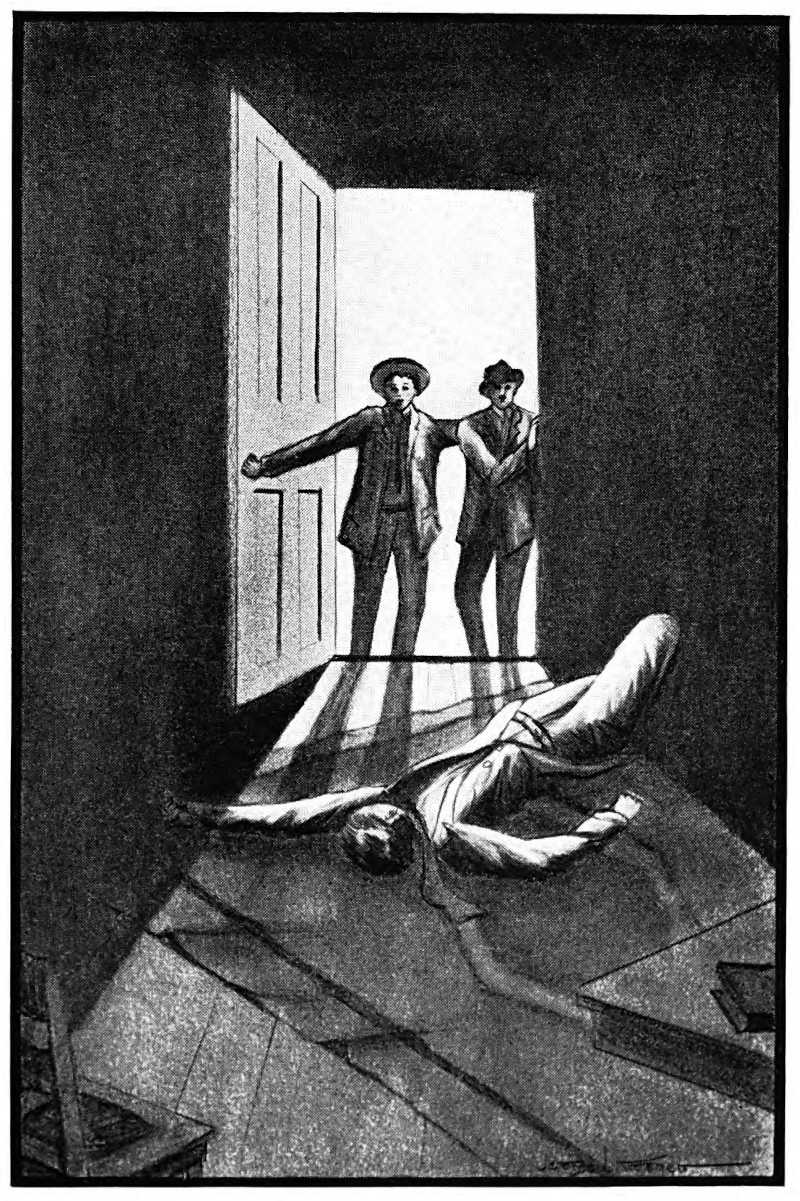
There the rescuers, somewhat overpowered by the strong and sickening odor, saw Joe lying in a heap on the floor.
[Pg 167]
“I’ll see if I can find any!” Helen cried, eager to help.
She darted into the house and made her way to the kitchen, whence she presently emerged with a pitcher of water she had drawn from the sink faucet.
Some of this sprinkled on Joe’s face, and a little given him to drink, helped wonderfully in the work of revivification the fresh air had commenced. The lad managed to rise to a sitting position, but there was a dazed look on his face.
“How did I get here?” he asked slowly. “How did you get here?”
“We don’t know much, except that we came to get you,” said Bill. “Are you hurt? Do you think you’re coming around all right, or shall we get a doctor?”
“I—I guess I’m all right,” Joe answered. “I’m not hurt, that’s sure. I was just overcome by some gas or ether.”
He drank some more of the water and then, at Bill’s suggestion, he walked around a bit to start his blood to circulating. In a little while some color came into the boy’s pale cheeks, and in a few minutes he declared he felt almost like himself again.
“But it was a queer experience,” he declared. “I can’t understand it at all. Did you see anything of that madman?”
[Pg 168]
“Clark, you mean?” asked Bill. “No, he seems to have run away. He is just what you say—a madman.”
“A dangerous lunatic,” agreed Joe. “He ought to be in an asylum. The idea of thinking I stole his flying machine invention!”
“Let’s get back to the show,” proposed Bill. “You can tell us the story on the way back in the carriage. Are you sure you don’t need a doctor?”
“Sure!” Joe answered, his strength of voice showing that he was rapidly improving.
The hack driver looked closely at his fares as he drove them back, but they did not satisfy his curiosity, for they did not want the story to be made public—at least not at present.
Joe told the story from the beginning. Helen sat near him in the carriage, and he reached out occasionally and touched her hand.
“And when I felt myself keeling over in a sort of faint,” Joe concluded, “I didn’t know what to make of it. The overpowering odor, whatever it was, seemed to come from some hidden pipe. It’s a mystery.”
“We’ll have it looked into by the proper authorities,” said Bill. “It isn’t safe to allow that lunatic at large.”
“How did you know where I was?” Joe asked.
“It was Helen,” said Benny; and when he told how the rescue had been brought about Joe indicated [Pg 169]part of his thanks to the girl by an eloquent look and a warm pressure on her hand.
“It was just by chance that I overheard you say where you were going,” put in Helen.
“But what gets me,” said Joe, “is why he had that queer room in his house—a room like a prison vault.”
They learned the reason for that a little later, when Bill laid the facts before the police authorities. Then the whole story was told, but no public complaint was made against the lunatic, as Joe and the other circus folk had no time to stay to press the charge.
But the police said they would have the madman taken into custody and sent to an asylum as soon as they could find him, though for the present he seemed to have disappeared.
The story of the unfortunate Mr. Clark was this: He was a wealthy man, as he said, and he had invented several machines. But he lost his reason, and at that time his family, disliking to send him to an institution, had had a strong room fitted up in the old homestead. The room was lined with steel, for Mr. Clark was of such a mechanical turn of mind that he would have escaped from an ordinary apartment.
At times he became so violent that it was dangerous to go into the same room with him, so a hidden pipe was arranged in order that a quieting [Pg 170]and harmless gas might be introduced into his vault. This would cause him to sleep, and he would then be quiet and apparently rational for weeks at a time, seeming as sane as any one.
But finally all his relatives died, and the authorities, after one of the unfortunate man’s outbreaks, sent him to an asylum. Treatment there seemed to effect a cure, and he was released, but only to go back again later. This occurred several times, but on the occasion of the man’s attack on Joe, the lunatic had managed to make his escape from the institution.
Just how Mr. Clark got the idea that Joe had stolen his invention was, of course, only to be guessed at. It was one of the queer kinks in his brain. But he seemed to want to get rid of Joe, and knowing of the hidden pipe leading to the vault had put some ether in it instead of the harmless gas that had been used on himself.
Then he had evidently run away, leaving Joe to his fate; and only for Helen’s wit, and the quick work of Bill and Benny, there might have been a different ending to the story.
During his sane, and perhaps during some of his insane, spells Mr. Clark would potter and tinker away at his “inventions” in the queer vault he made his workshop, and whither he had lured Joe. “Well,” said the chief of police, to whom complaint was made about the lunatic, “we’ll put him away as [Pg 171]soon as we can. And the old house is soon to be torn down, so there’ll be no more danger there.”
“Then he told the truth about that,” remarked Joe.
“Oh, yes. He is cunning like all insane persons, and speaks the truth at times. It’s a sad case, but I’m glad you got out all right.”
Jim Tracy, when told of what had happened, wanted Joe not to do his turns that night. But our hero, after a cold shower bath and a good meal, said he felt as well as ever, and would not disappoint the crowds. Accordingly, he performed his motor-cycle and flying feats, but he only did part of the tank act, not staying under for any great length of time, as he did not want to tax his lungs, which showed some slight effects from the ether.
The show moved on, but later Joe and his friends learned that the unfortunate Mr. Clark had been sent to an institution, whence there was little hope of his coming out.
“I wish I knew his secret of a powerful and light storage battery,” said the young circus performer. “I’ll need it if I want to make a bigger Bat.”
“Are you going to keep on with the circus?” asked Helen.
“Yes, I think I shall. I’ve a lot of plans in my head for a bigger and better show if I can ever raise the money. I just wish my English inheritance would ‘make good.’ I’d use that money in the [Pg 172]circus, and I’d build a bigger flying machine. Would you double up with me in that act, Helen?”
“I don’t know,” she answered hesitatingly. “Now that you are one of the owners, and when you have a bigger show, you may have no use for a performer like me.”
“The day will never come when I won’t want you, Helen,” said Joe in a low voice. “But I guess it will be a long while before I get enough money to do what I want.”
It was about a week after this that something came to Joe’s attention which caused him to do some hard thinking. He had subscribed to a London paper some time before because of his interest in English affairs. Occasionally the copies went astray in the mail on account of Joe’s travels, but this number came safely with some letters. And in reading the journal Joe saw a notice to the effect that charges of professional misconduct were to be made against a lawyer named Kent Bolling.
“Why, that’s my lawyer!” exclaimed Joe. “I wonder if he is dealing straight with me. I’ve got to look into this thing. It seems suspicious to me. I’ve got to do something!”
[Pg 173]
Joe was not in a position to go to England to try to straighten out his affairs, much as he wished to do so. His new position, as one of the partners in the circus, and the attraction his acts were to it, made it impossible for him to leave.
“But if I don’t get things straightened out before, I’ll take a run over when we go into winter quarters,” decided the lad. “I’ll need a little vacation, anyhow, and a trip to England will do me good. I may pick up some new ideas about circuses.”
“So you might,” agreed Helen, in whom Joe confided, also showing her the article in the paper.
“But for the present I’ll have to learn what I can by writing,” the youth went on.
“I’ll help you,” offered Helen.
Together the young people outlined a sort of letter-writing campaign. Joe sent notes to the persons mentioned in the London paper as carrying on the investigation into the conduct of Mr. Bolling. He also wrote to the solicitor who had first acted in the matter of the English estate, begging him to [Pg 174]use again his influence to straighten the matters out and take Joe’s affairs from the hands of Mr. Kent Bolling.
“And now we can only wait,” the youth said, when the last of the epistles had been mailed.
Meanwhile matters were going fairly well with the circus. Several times the big tent was crowded to its capacity, and some of the crowd had to be turned away. At other times the attendance would be rather less. And being now a partner, whose money varied with the success of the show, Joe took more interest in the attendance than formerly.
Of course, he had always been glad to see a crowded tent, as any performer is. It is much easier to act and do one’s best before a big audience than in front of a slim and unsympathetic one. All actors realize this.
The circus reached the city of Ralston and played to good business there for two days and two nights. The next stopping place was Mortville, which was the center of a thriving community, and where they expected also to do well.
“I think, instead of going by train, I’ll make a night hike of it by highway,” said Mr. Sampson, when considering the matter of moving the show to Mortville. “The performers can ride, of course, and we’ll send our cars by rail, but it’s a roundabout route and we’ll get in so late it will mean cutting out the parade.
[Pg 175]
“That’s too good an advertising feature to omit, and we won’t have to do it if we drive the animal and other wagons, and move our horses across country by road.”
“How’s that?” asked Jim Tracy.
“Why, there’s been a new state road opened between Ralston and Mortville, which makes it about fifteen miles shorter than it used to be, and much less than the railroad makes it. To go by rail we have to go to Benton Junction and then double back. If we go by the state road we can go direct. This will bring the wagons to the lot early in the morning, and we can get the preliminary work done in time to prepare for the parade. The performers can have breakfast on the train, and they’ll be in on time to take part in the procession. It’s the early morning work—erecting the tent and all that—which takes time. So we’ll make a night hike.”
This had been done occasionally before on short trips, but not since Joe had been with the show. And when he heard what was going to be done he said:
“I think I’ll ride on one of the wagons.”
“What for?” asked Jim Tracy.
“I want the experience,” was the answer. “Now that I’m one of the partners, I want to learn all I can about the details of circus management.”
“That’s a fine idea,” said Mr. Sampson. “Ride by all means. It’s going to be a nice moonlight [Pg 176]night, and I’d take the ride myself only I want to look after the train details.”
So it came about that when the tents were struck that night, and the canvas, poles, stakes and ropes piled in the big wagons, the vehicles started off on the road, each one pulled by eight sturdy horses.
Joe took his place on the seat of one of the canvas wagons alongside of the driver, who handled the many reins with as much ease as the average man does a single pair.
Joe was familiar with all the life of a circus except this night-moving by road, and he was keenly interested in it. Along the new highway, illumined by the mellow light of the moon, the circus cavalcade proceeded. Joe’s driver was Terry Bland, an old hand at the business, and he told the lad many stories as they drove along.
“You can crawl back on the canvas and go to sleep when you like,” he said to Joe.
“Oh, I don’t want to,” was the answer.
“You’ll need it, if you expect to do all your acts to-morrow,” Terry went on. “I’ll have a chance to sleep after we get in and unloaded, as I always do. But you won’t. Better get a nap.”
“I will maybe, a little later,” Joe agreed. At present he was too interested to leave his high perch on the seat of the big wagon. But after an hour or so it grew rather monotonous, listening to the rumble of the heavy wheels and the tramping of the [Pg 177]hoofs of many horses, and Joe decided to take the driver’s advice. He made as comfortable a bed as possible on the canvas, covering himself with part of it, and soon was sound asleep.
How long he slept he did not know, but when he awoke, with something of a start, he found that the wagon was not moving.
“Hello!” he cried, starting up. “Are we in?”
“Not yet,” was the answer. The voice did not come from the driver’s seat. Joe looked forward, but did not see Terry.
“What’s wrong?” he asked in some alarm, as he crawled out. He could see nothing of the other circus wagons.
“Nothing much,” was the reply, and the voice came from down on the ground, at the side of the vehicle. “One of the wheel-nuts was rattling, and I got off to look at it. Found it was quite loose, so I’m tightening it. Took me longer than I expected and the rest of the procession has gone on. We’ll soon be up with ’em, though.”
A little later, having fixed the wheel to his satisfaction, the driver mounted to his seat and they set off again. It was slightly down grade, and as Terry wanted to catch up to the wagons that had gone on ahead he called sharply to his steeds. They responded with a brisk canter which took them along at good speed.
“It’s rather sharp out,” commented the driver. [Pg 178]“Begins to feel like fall, especially in the early morning,” and he slung one arm against his chest, beating it to start the blood circulating more rapidly.
“Yes,” agreed Joe. “But I like it. When I was a kid in the country I used to——”
But he did not finish the sentence, for, just then, the wagon jolted over a stone and lurched so much to one side that the driver was pitched off and fell to the ground, losing his grip on the many reins.
Joe had a momentary view of Terry, falling clear of the ponderous wheels to the grass beside the road, and then he realized the necessity for prompt action, as the horses, frightened perhaps by the jolt of the vehicle, started to run away.
“Here’s trouble!” flashed through the lad’s mind. “A big heavy wagon, and eight horses running away down hill! I wonder if I can work the brakes.”
Even as he thus thought, the youth acted. The reins were fastened to a hook at the side of the seat and did not fall when Terry dropped them. Joe grasped them in both hands and began to pull in on the team. He dared not look back to see what had become of the driver, but he hoped a severe shaking up would be the only result of the man’s fall.
Joe knew something about horses, though he had never driven a circus team.
Calling soothingly to the frightened and galloping animals, Joe began pulling them in. At the [Pg 179]same time his feet found the brake bar, which extended across the whole front of the foot-rest below the seat, and with all his might he pressed on it.
For a moment it seemed as if it was going to be of no avail. The hill was steep at this place, and the wagon was swaying dangerously from side to side. But the brake was of a new lever kind, and exerted great power. The grip on the wheels soon began to tell. Slowly the speed of the wagon slackened, though only the two horses nearest the vehicle could put any holding-back strain on it. Joe was afraid lest one of the animals should fall and bring the whole eight down in a heap together. But the circus horses were sure-footed, and nothing like that happened.
It was not until the bottom of the slope was reached that the wagon was completely stopped, and Joe breathed more easily. He looked back and saw coming along the moon-lit road a limping figure which he recognized as that of Terry.
“Well, he’s alive, anyhow,” thought the lad.
“First time that ever happened to me!” the driver exclaimed as he came up. “I never fell off a seat before. Say, boy, you brought that team up in great shape! Only for you there would have been a bad mess.”
“I was afraid, myself, that was going to happen,” said Joe.
[Pg 180]
“You certainly did it mighty slick,” went on Terry. “And this is one of the hardest teams to drive in the whole show.”
“Are you hurt?” asked Joe.
“Just sprained my leg a little. But that’s nothing to what might have happened. I’m glad you rode with me to-night.”
“So am I,” returned the lad.
It was lucky, indeed, that Joe Strong had been along, and when the show got in in the morning and Mr. Sampson heard what had happened, he was very grateful to the youth. Part of the main tent was in that wagon, and had there been an accident, and had it been delayed, there might have been much trouble.
The tents were erected and preparations made for the parade before the train containing the show-folk arrived. Mr. Sampson’s plan of a night road journey proved to be a good one, the runaway team being the only thing that somewhat marred it.
The circus met with a good reception in Mortville, and it was here that another phase of the queer tangle that seemed to involve his English matters occurred to Joe.
The afternoon performance was over and the young circus actor was getting ready to take Helen out for a ride on his motor-cycle when a note was handed to him. It bore no stamp, and seemed to have come by messenger.
[Pg 181]
“Where did you get it?” asked Joe of the circus attendant who had handed it to him.
“A boy brought it just now.”
“Messenger boy?”
“No, just an ordinary kid.”
“Where is he?”
“He didn’t wait, though I told him there might be an answer.”
By this time Joe was reading the note. Its contents puzzled him, for all it said was:
“If you would like to get some inside facts about your English affairs, come to the Globe Hotel at once and ask for Perkins. But come alone or it’s all off.”
“Humph! this is queer,” said the boy.
“What is it?” asked Helen.
Joe showed her the note.
“Are you going?” she asked.
“I think so.”
“Oh, Joe, I wouldn’t!”
“Why not?”
“This may be another trap, like the one that unfortunate Mr. Clark set for you. Maybe it’s from him.”
“It isn’t likely,” Joe said. “He was put in the asylum and I guess he hasn’t gotten out. Besides, this is at a public hotel here in town. I can’t come [Pg 182]to any harm there. I guess I’ll go and see what Mr. Perkins has to say. You don’t mind waiting for the ride?”
“Of course not, Joe. Only do take care of yourself.”
“I will,” he promised. “And I’ll come back as soon as I can.”
The Globe Hotel was the principal hostelry in the place. It was on the main street, and Joe soon reached it.
“Perkins?” repeated the hotel clerk when Joe asked for the name specified in the note. “There he is over there,” and he pointed to a man who looked as if he had just come over from England.
“Mr. Perkins?” asked Joe, questioningly.
“That’s I!” exclaimed the man, with a strong English accent. “And are you Mr. Strong?”
Joe nodded in assent.
“I’ve got a proposition to make to you,” Perkins went on. “I’m glad you came alone, for I don’t want my business known. If you’ll just step in here we can have a quiet chat,” and he indicated a small alcove off the main corridor.
Certainly there could be no danger in that, Joe thought, for he was in plain view of the hotel clerk, and Perkins did not seem to be anything but a harmless individual.
“What’s it all about, and why are you so mysterious?” asked Joe.
[Pg 183]
“I have to be,” was the low-voiced reply. “Now to get down to business. If I help you get what money is coming to you from your mother’s estate in England, will you share it with me?”
[Pg 184]
Joe was taken aback by the man’s strange proposition, and he plainly showed the surprise he felt.
“Oh, it’s a straight offer!” exclaimed Perkins. “I know it may sound a bit queer to you, but it’s done every day on the other side.”
“How did you come to be interested in my affairs?” asked Joe, wishing to gain all the information he could.
“I have friends among the lawyers across the water,” he answered with a grin. “They tip me off occasionally when there’s a bit to be made on the side. And I came over here on purpose to see you and make you an offer.”
“You came on purpose to see me?” cried Joe.
“Certainly. I was willing to spend money for a passage on the chance of making a good sum, and there’s quite a bit due you as I understand.”
“Yes, there is. Though how you found it out, I don’t know,” said the youth. “But why should I share my money with you?”
“Because I’ll help you get it.”
[Pg 185]
“Can’t I get it myself?”
“I don’t think so,” the fellow replied, with a grin. “You haven’t been getting it very fast, have you—not since the first installment?”
“Well, that’s true enough,” Joe said. “But I have taken steps to compel a settlement which has been rather slow.”
“You’ll never be able to get a settlement on your own account,” declared Mr. Perkins.
“Why not?”
“Because you don’t know the ropes, or all there is to be known.”
“And how do you happen to?”
“Because I’m on the inside, I tell you. Now look here, Mr. Strong!” and the man’s manner was earnest, though he kept his voice low, and looked over his shoulder occasionally as if he feared some one. “I know more than I’m telling, but I’m not going to give away all my secrets until you promise to whack up with me. If I help you collect your money, which you can’t get any other way, you surely ought to be willing to pay for my services.”
“I’m willing to pay for any legitimate help,” said Joe. “But what do you mean when you ask me to ‘whack up’ as you call it?”
“Go halves, of course.”
“Halves!” cried Joe.
“Hush! Not so loud, I beg of you,” whispered [Pg 186]the man. “Half is what I usually get on cases like this.”
“Then this is your business—settling up disputed estates on a fifty per cent. commission?”
“Well, it’s my profession on the side. Sometimes I get more than half, and sometimes less. I’d have to get half in this case, to cover my expenses.”
Joe pondered for a moment. He did not like the idea of giving up any portion of his estate, except, perhaps, the amount the regular lawyers would charge. But then it might be better to take up this fellow’s offer in order to get a quick settlement, he reflected.
“Though I’ll not give him half, or even a quarter,” decided the boy.
“Well, what about it?” Perkins asked, a bit impatiently.
“I’ll consider the matter,” Joe replied, “and let you know later what I’ll do about it. Just now I——”
“Joe!” interrupted a voice behind him, “excuse me but a cablegram came for you and I brought it here, thinking it might be urgent.”
Joe looked up to see Benny Turton standing near him. Perkins also saw Joe’s friend, and an angry look came over the man’s face.
“I told you it would be all off if you brought any one with you!” the Englishman cried, ignoring the fact that Joe had not brought Benny, who had come [Pg 187]in later, and unexpectedly. “Now the game’s up! I won’t have any dealings with you!”
And the man, without further ceremony, rushed from the place, leaving Benny and Joe staring after him in surprise.
“Well, what ailed him?” asked Benny.
“He seemed afraid of you,” his chum answered.
“I never saw him before in my life that I know of,” returned Benny.
“Then he didn’t want any third party to hear what he was saying. It’s a queer game, Ben. I’ll tell you about it in a minute, but first I must read the cablegram.”
“I thought maybe you might want it,” went on Benny, “and as Helen said you were here on some business connected with your English estate, I came on. Maybe the cablegram has to do with it.”
“It has,” Joe answered. “It’s from the lawyer who did such good work for me at first. He has agreed to take it up again, and he’s going to get right after this Mr. Bolling, who, I begin to think, is something of an incompetent, if not a scoundrel.”
“And who was this fellow, Joe?”
“Well, I didn’t get very far toward finding out, he ran off so suddenly. But he made me a queer offer. I should like to have a chance to talk more with him. I must ask the clerk about him.”
But the clerk knew very little of Mr. Perkins beyond the fact that he had come to the hotel that [Pg 188]day, and did not seem to have any particular business. He had a cheap room, near the roof, and had said he would probably remain only a day or two.
Joe and Benny looked about the hotel for him, but Mr. Perkins appeared to have taken himself off, though why he should have fled so suddenly, just because Benny spoke to Joe, was beyond the comprehension of both young men.
Joe told his friend the whole story of Mr. Perkins, deciding it would be best to have a witness in case of proceedings later.
“Well, it certainly was a queer game,” said Benny. “Do you think he could be in with Bolling?”
“He didn’t mention his name. But he certainly knew some inside facts about my affairs.”
“Do you think you’ll have any dealings with him?”
“I might, Benny, if I can’t get my money any other way. But he will have to modify his terms. Fifty per cent. is too high.”
“I should say so! But before you do anything, why don’t you wait and see what this other lawyer can do? The one who sent the cablegram. He may help you.”
“I guess I will wait. Much obliged to you for bringing it to me. Well, I guess Mr. Perkins isn’t going to show up around here right away, so we [Pg 189]may as well go back to the circus. I promised to take Helen for a ride.”
“I notice you don’t take Miss Tyndall any more,” said Benny, with a mischievous smile.
“No, I guess it’s safer not to,” laughed Joe. “I like her, but—well, you know how it is.”
“I guess so,” agreed Benny, with a broader smile on his face.
It had been the plan that the circus should stay only one day in this city, but on getting back to the grounds Benny and Joe found a change had been made in the arrangements. Word had been received that at the next stopping place a big fair was in progress which would probably interfere with the attendance at the Sampson Brothers’ Show. And as there was still a large population to draw from in Mortville, it was decided to remain over night, and to give two shows and the usual parade the next day.
“Well, that suits me,” said Joe. “I’ll have another chance to have a talk with Perkins.”
“How do you suppose he found you?” asked Helen, to whom Joe told what had happened.
“He said he came over from London on purpose. Of course the lawyers there have my address, and lately I sent them a complete schedule, stating where the circus would be every day. So Perkins must have known we’d be here on, or about, this date, and he came to wait for me.”
[Pg 190]
Joe’s acts, as well as those of the other circus performers, seemed to please the big audience in the crowded tent that night. There was generous applause, and Joe expected more when he did the funny countryman act of falling into the tank with Benny and the trained seal.
The boy had taken off his shimmering white suit—the one he wore when he rode the motor-cycle and drove the Bat, and was attired in a big, loose, clumsily-made suit, with large boots—the stage farmer’s outfit. Under it was the water-proof suit for use in the tank.
The boy, in his make-up, took his seat among the spectators, of whom he was supposed to be one. Lizzie, the trained seal, was loosed from her crate to flap her way to the steps of the platform on which the tank set. The lithe animal started on her journey, and Joe, according to the programme, started after her, pretending to think she had got loose by accident. At the same time, a little boy sitting near Joe also got up, and before his father could stop him, had run close to the seal.
“I want it! I want it!” the child cried. “I want it to play with!”
For a moment there was more confusion than Joe had bargained for. He knew he must get the child, for sometimes Lizzie snapped at strangers who touched her, and she had teeth of razor-like sharpness. [Pg 191]She could bite off the hand of the child as easily as she could bite through a large fish.
“Come back! Come back!” cried Joe. But the child was fleet of foot, and our hero had fairly to leap forward. Even then he was only just in time to snatch the youngster away as he laid a little hand on Lizzie’s smooth back.
The seal, feeling a strange touch on her, turned with a growl and showed her teeth, snapping at the hand of the boy. But Joe had him out of danger, though the little fellow did not realize from what he had escaped.
“Don’t play with circus animals, bubby!” cautioned Joe as he handed the little one to the startled father. Then Joe had to go on with his own part in the act, ending up, when he could not catch Lizzie before she flopped into the tank, by falling in himself.
Joe and Benny did the double turn under water, and that ended Joe’s work for the night. It had been a full day for him, counting in his ride on the circus wagon.
As usual, in the parade the next day Joe rode in the flying machine on the back of Rajah, the big elephant. The procession was wending its way down one of the city streets, but Joe noticed that the usual crowds were not present.
“What’s going on? Is there a counter attraction?” he heard one of the circus horsemen ask a [Pg 192]mounted policeman—one of several escorting the circus parade.
“Big fire a few blocks down,” was the answer. “The Globe Hotel is burning! You can see the smoke of it!”
Joe looked in the direction indicated, and saw a black pall mounting over the trees.
[Pg 193]
“That’s some fire,” remarked Joe to Tom Layton, the elephant man, speaking over the top of the howdah in which the boy stood ready to make his flight, not yet having arisen on his wings of steel.
“It does look that way,” was the reply.
Suddenly a wave of excitement seemed to sweep over the crowd. Word was passed from one person to another until it reached the policeman who had given the first information of the fire.
“What is it?” called Joe to the officer.
“The fire’s getting worse,” came the answer, “and there’s a report that a number of people are trapped by the flames.”
Joe let out a whistle, and a sudden resolution came into his mind. But the policeman was not through imparting information.
“That’s not the worst, either,” he said.
“Why not?” the elephant man wanted to know.
“Because a good part of the fire department is out of town on their annual outing, and there’s not [Pg 194]half enough men left to fight a big blaze. They took some of their biggest ladders with them, and as the Globe Hotel is the highest building in town it’s going to be a job to get the people off the roof.”
“Is that where they are?” asked Joe.
“That’s what they say.”
By this time the excitement over the fire had grown to such an extent that crowds were deserting the attraction of the circus parade to go to see the conflagration. From his elevated position on the back of the elephant Joe could see the smoke getting thicker, and he could note the sharp tongues of flame darting through it.
“I’m going to see that fire!” cried Joe to the elephant man.
“Yes, we’ll be nearer to it pretty soon,” was Tom’s comment. “Though whether they’ll let the parade through that street is a question. Most likely they won’t.”
“I’m not going to wait for the parade to get there,” Joe made answer. “It’s likely we’ll be held back, as you say. I’m going to fly down there. I want to see it at close range.”
“All right. Do as you please. I guess we’ll abandon the parade anyhow. Nobody seems to be taking much interest in it.”
This was true enough, for the crowds were now running down the main thoroughfares in the direction [Pg 195]of the burning hotel. The parade was “playing to empty streets,” as it were.
Joe lowered the cloth sides of the little house on the elephant’s back, and made ready to rise in his wings of steel. He threw over the switch that controlled the electric current, and the motors hummed and throbbed as the gear wheels and torsion rods transmitted the power to the wings.
Up and down flapped the big wings of the Bat, and Joe slowly left the elephant’s back. A few of the throng turned to watch him, and there were the usual expressions of wonder, but all eyes were soon turned toward the big fire, which, as Joe could see, was assuming large proportions.
Up and up rose the young acrobat, up toward the low-lying clouds, and then toward the other clouds of smoke he directed his flight. He could see the still-moving circus procession below him, and the crowds of people, and then he had a glimpse of the hotel—a better view than had yet been afforded him.
“I can’t see any persons on the roof,” said Joe, as he turned on more power. “Still there may be some. And with no ladders to get them down—well, maybe they can use the fire escapes if the inside stairs are burned away.”
It did not take the young aviator long, in his marvelous flying machine, to reach the scene of the conflagration. He went down a little lower, approaching the burning hotel on the side where there [Pg 196]was the least smoke. Though his wings made comparatively little noise—certainly not enough to be heard by the crowd above the racket caused by the fire and the means being used to subdue it—Joe saw hundreds in the throng looking up at him. And, for a time, attention was divided between him and the blazing hotel.
It was a hard matter for Joe to find a clear place on which to make a landing, but he managed it and came to rest where he could get a good view. People at once crowded up around him, for they had seen on the circus bills a representation of Joe flying in the Bat and they wanted a closer view.
Suddenly a cry came.
“Look! Look! There they are!”
Hundreds of hands pointed toward the roof of the hotel.
And there, as the smoke was rolled back by a gust of wind, Joe saw a number of men and one woman huddled together on the flat roof of the hotel. And in that instant they held out their hands in mute appeal to the crowds below them.
“Can’t they save them?” asked Joe.
“They can’t seem to,” half a dozen voices answered him.
“Why not?” demanded the young acrobat, as he looked at the firemen dragging up more lengths of hose.
“No ladders long enough.”
[Pg 197]
“They took the longest ladders over to Tarnytown to the contests there,” some one said.
“There isn’t a ladder made long enough to reach to the roof of that hotel,” declared one man. “They could use scaling ladders, or a rope maybe, but the trouble is that the fire is about the middle of the hotel, and they can’t get up past the windows—they’re spouting fire on all four sides.”
This was true enough. The fire had started on the eighth story of the Globe Hotel, and had quickly spread out fan-wise on that and the floor above and below. The hotel was of what is called “slow-burning” construction, and was not absolutely fire-proof.
“Aren’t there any fire escapes?” asked Joe.
“Yes, there are some,” a man in the crowd replied, “but they didn’t build one that can be reached from the roof. The nearest one is some distance down, and it would be a risky jump from the roof to get to it.”
“And the inside of the hotel is a roaring furnace where they’d have to pass if they tried the inside stairs,” another said. “They’re doomed!”
Once more the smoke rolled back and hid from view the unfortunates on the roof. How they got there no one could say, but probably when the fire was discovered they had, in their fright, rushed up instead of down, as had most of the hotel inmates. And again, it may have been that they tried to [Pg 198]descend, but found their way cut off by burning stairways. At any rate they were on the roof, frantically appealing to those below to save them.
“Why don’t the firemen do something?” demanded a hysterical woman near Joe. “Surely they can save them!”
“How?” asked a man gloomily. “If they had wings like these here,” and he indicated the Bat, “they might fly down. But that’s the only way. No ladder can reach them.”
“Can’t they throw them up a rope?” persisted the woman. “They might fasten that somewhere on the roof, and slide down. I’ve heard of people saving themselves at fires by coming down ropes.”
“It could be done if we could get a rope up to them,” a man admitted. “But who could toss a line up there?” and he pointed to the high roof. “Not the best sailor living could do it.”
“But shoot a rope up in some way—as they shoot a line to sinking vessels at sea!” a new voice cried.
“That needs a cannon, and there’s no time to get one,” was the despondent comment. “It takes special apparatus to do that. There isn’t any in the city. A man with a bow and arrow might get a light line up, so they could haul up a heavier one.”
“Get a bow and arrow!” arose a general cry. But no one, in the excitement of the moment, knew where to go for them.
[Pg 199]
It was then that Joe Strong stepped into the breach.
“I’ll carry a rope up there if you get me one,” he said.
“How?” some one near him asked.
“With my wings of steel. I can fly a good deal higher than that roof.”
For a moment no one spoke, but as the crowd looked at Joe and his strange machine it was evident that the problem was solved. At least an attempt could be made to save the unfortunates.
“Get me a rope!” cried Joe. “I’ll carry it up!”
“The firemen have ropes,” came the information.
A dozen in the crowd rushed for the nearest hook and ladder truck. On that were carried ropes, life-nets and other special appliances for use in saving lives. But up to now there had been no chance to bring them into play.
A long, light, but strong rope was brought to Joe, where he stood ready to make his perilous flight in the Bat. For it would be perilous. He might land on the roof just as it collapsed. That this would happen soon could not be doubted, for the fire was still burning fiercely in spite of the tons of water poured into the heart of it. And then, too, there was always danger in flying—something might break and let the machine fall. But the lad did not count that chance much.
“Stand ready to pay out the rope as I go up,” he [Pg 200]directed those who had brought the cable to him. “Don’t let it get tangled, or it will pull away from me—maybe pull me down. And when I have my end up there be ready to fasten this end to something so they can come down the rope. Make it good and tight.”
“Yes! Yes! We’ll do that!” was the eager response. “Go on up with the rope!”
Again the smoke cloud parted and another view could be had of the imperilled men.
“Where’s the woman?” some one cried.
“She’s burned!” a man murmured hoarsely.
“They’ll all be burned soon,” another added.
But Joe Strong was doing his best to save them. He attached the rope to his machine, and again cautioning the men in charge of it to see that it paid out well, he turned on the power in the Bat.
In a moment he began rising, but he could no longer see those on the roof, for the smoke had rolled in again.
Up and up went the lad, the rope trailing out behind him. He could hear cries of wonder from the crowd now, for he was in plain sight and what he was about to do was evident to all.
“He’s going to save them!” was shouted on all sides. “That circus flying machine boy is going to save them!”
In his heart Joe hoped he could.
[Pg 201]
Contact by contact Joe shoved over his electrical switch until he was using full power in the motors, and the big wings were flapping and fanning the air, carrying him up to the hotel roof.
The fire in the middle of the building was fiercer now, and the flames, having crept up two more stories, were almost as high as the roof itself. On two sides there was a wall of smoke, through which it would be difficult to pass. On the other, tips of flame occasionally shot up, leaving but one side over which the rope could be passed so there might be a chance for life.
“One chance out of four,” mused Joe, as he looked up at the roof, “and that chance may go any second. It’s a slim outlook.”
The rope was paying out freely, and he realized that he had capable helpers on the ground below.
Though the youth was steering his craft some distance away from the hotel, intending to come closer as he got beyond the fire zone, he could feel the heat of the flames as they belched out of the windows. It was a fierce conflagration.
[Pg 202]
Higher and higher he went, until finally he was ready to sail in and land on the roof, being well above the burning hotel. The imperilled ones saw him, and raised their hands in mute appeal. Joe could see them shouting to him, but the crackle of the flames was so great he could not distinguish the words.
“There’s the woman,” he murmured, as he saw a huddled female form lying on the roof. “She isn’t burned. Only fainted, I guess. But how will they get her down the rope, unless one of the men carries her? And that’ll be no easy work.”
But Joe had too many things to think of just then to allow himself to dwell on that detail. That could be taken up when it was reached. Squarely over the middle of the roof the lad guided his wings of steel. He saw the open scuttle by which the men and the woman had reached their positions. The roof had not burned through in any place yet, but it was smoking over in one corner, and it was only a question of a few minutes before it would break into flames.
Joe glided down in the Bat and, as the men on the roof rushed toward him, he quickly got out of the frame.
“Can you save us?” one young fellow asked frantically.
“I’m going to make a big try!” cried Joe. “Is that woman dead?”
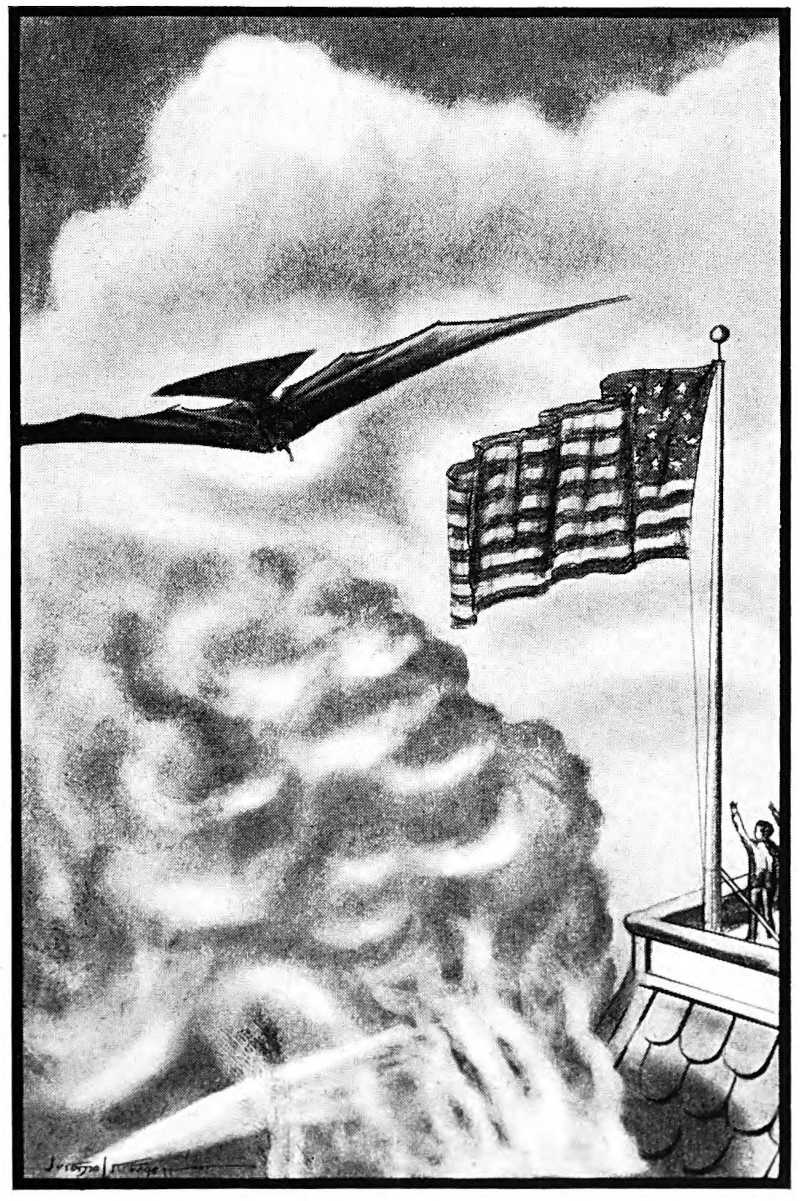
Joe glided down in the Bat as the men on the roof rushed toward him.
[Pg 203]
“No, only fainted,” some one answered.
“Lower her down first!” cried a big man, whose clothing was scorched, showing how narrow had been his escape from the flames. “I see you brought up a rope,” he added. “Lower the woman first!”
“That’s what!” came the general cry. “The woman first!”
“We can’t lower her!” said Joe.
“Why not?”
“Because flames are shooting out of the windows on all four sides of the hotel below us. We might pick out a spot where for the moment there would be no fire, but it might burst out any second and burn the rope through. It can’t be done. If I had a steel rope it would be all right, but I haven’t.”
“How you going to save us then?” demanded a man.
“By a slanting rope. We’ll fasten this to the roof here. Down below there they’ll carry it out some distance and make it fast. Thus the rope will be held away from the flames for a time, and you men can go down it hand over hand. It’s the only way. Quick now, the roof may soon fall!”
“But what about the woman?” persisted the big man. “We’ve got to save her. I won’t go down to face that crowd and have it said I left a woman back here to die!”
“I won’t either!” cried the others. “We’ve got to save her.”
[Pg 204]
Joe did some rapid thinking. For a moment he thought he might take her down in the Bat. It would not lift double, but it might safely soar down with his weight and that of the woman. But then, as he saw the parapet, or raised wall of masonry, around the edge of the roof, put there as a sort of guard rail, he knew his plan would not work. He would have to make the Bat lift him and the woman over that parapet and it could not be done. There must another way be found.
“Can one of you men carry her?” he asked, nodding toward the unconscious form.
“It would be pretty hard to do it and go down the rope,” said one man. The others nodded their agreement. Then the big man had an inspiration.
“Will the rope hold double?” he asked.
“Yes, and more too,” said Joe, who knew something about ropes from his circus experience.
“Then cut off an end of it, tie the woman to my shoulders, and I’ll go down the rope with her on my back,” cried the big man.
“Are you sure you can do it?” asked Joe.
“I used to be a sailor,” was the quiet answer.
“Then go ahead,” advised Joe. “Make the rope fast while I fix some holding loops with the piece we cut off.”
It was the work of but a few seconds for the sailor to make a tight knot around a projection on the roof. Meanwhile Joe, using the extra piece [Pg 205]of rope, made loops around the woman’s shoulders and waist. She could thus be held on the big man’s back in an upright position.
Once the main cable was made fast, Joe signalled to those on the ground to carry out their end and make that fast.
“All ready now!” called the young acrobat.
The fire was raging more hotly now. In one corner of the roof there was a little tongue of flame showing. The roof had burned through and puffs of smoke were coming up. It was a question of minutes—nay, seconds—now.
The rope passed from the roof to the ground on a long slant, and thus, instead of dangling straight down the side of the building, where it would have been burned by the flames spouting from the windows, it was at a safe distance above the fire.
“Come on! Come on!” cried Joe. “Who’s to go first?”
“Let him,” spoke a young man, pointing to the one who had offered to carry the woman.
They fastened her to his back. She was now slowly regaining the consciousness she had lost through excessive fear, but she was in no condition to help herself.
“Well, here I go,” said the big man. He climbed over the parapet and then, using care and caution, he began to descend the rope, hand over hand.
A great cry arose from the crowd below as [Pg 206]they saw the first of the saved ones coming from the place of peril.
“Wait until he gets down a way, and then one of the rest of you try it,” advised Joe.
“I’m very light, I might go now. I wouldn’t add much to the rope,” spoke a voice close to Joe. He started at the sound of it—for it was decidedly English in accent.
“Perkins!” he exclaimed, recognizing now the man who had made him the strange offer about his estate.
“Mr. Strong!” cried the Englishman. “I didn’t know you before—I’m that excited!”
And Joe had not recognized the fellow whose face was covered with smoke and dirt. It was the voice that brought recognition. If the man had spoken before Joe had been too excited to notice it. But it was Perkins surely enough.
“Yes, go on,” said Joe. “You are a light weight.”
“You—you’ve saved my life!” was the comment. “I won’t forget it, Mr. Strong.”
“Hurry!” was all Joe answered.
One after another the men followed down the rope. It bore their weight safely, and only in that way could they have been saved.
Joe’s idea had worked out well.
Cheer after cheer came from the crowd, as those who were anxiously waiting below saw the men leaving their place of danger. Joe looked down and [Pg 207]noted that the big man, who had carried the woman on his back, was safe on the ground now. Willing hands were caring for the waitress, for Joe afterward learned she was one of the hotel servants.
And then, when he saw the last man start down the hempen way to safety, the lad got in his wings of steel and turned on the power. The wings vibrated, and up he rose.
Only just in time, too; for as he passed over the parapet and began to soar away from the hotel, one corner of the roof caved in, and up shot a burst of sparks, flames and smoke.
“A close call!” exclaimed Joe, as he increased his rate of sailing in order to get away from the crater of the volcano he feared might soon represent what had been a hotel.
Joe was received with wild acclaim when he reached the ground. It seemed that every man, woman and child in the crowd wanted to clasp his hand—to touch him somewhere—as he came out of the Bat. Cheers were given for him, though few knew his name even, except as they had seen it on the circus posters.
“It was the greatest rescue I ever saw!” cried a man, and others echoed his words.
By this time firemen from a neighboring municipality had come up, and with their help the other handicapped fire-fighters, who were short-numbered, were better able to cope with the flames. Though [Pg 208]the roof had burned through there was now a chance of getting the fire under control, though the upper half of the hotel was a mass of ruins. Only the fact that the conflagration had started in the middle, whence it burned up instead of down, saved any portion of it.
“Well, I guess I’d better get back to the circus parade,” Joe thought, as soon as he could get out of the crowd. He again rose in the air until he was high enough to see the procession wending its way back to the lots. The parade had been given up when half over. The fire was too big an attraction with which to compete.
“You covered yourself with glory again, Joe,” cried Jim Tracy a little later. “It was great!”
“Oh, it wasn’t much,” said Joe modestly.
“Yes, it was—I saw it,” declared the ring-master. “And if we don’t play to the biggest day and night since you won the aviation prize, I’m no prophet.”
Jim Tracy was a good prophet, and throngs had to be turned away from the show, even though straw was spread around the ring to allow hundreds to sit on the ground. And Joe Strong was cheered again and again as he sailed around the tent in the Bat which the crowd knew at once as the life-saving machine.
At night it was the same. And so many had to be turned away that the management decided to stay [Pg 209]another day in the place as business, thanks to the young aeronaut’s advertising, was so good.
Joe was interviewed by several newspaper reporters, and his picture was in more than one journal as one of the heroes of the day.
“It was all because of the wings of steel,” said the boy. “In them any one could have gone up.”
“I guess we’ll have to equip the fire department with a set,” said a deputy chief who called to thank Joe. “They’d come in very useful in another case like that.”
“I hope you don’t have any more cases like that,” observed the young hero.
“So do I,” echoed the fireman.
It was the day after the rescue that Joe, in his tent, received word that some one wanted to see him. Not wishing to admit any more cranks or madmen, he went out to see who it was. He saw Perkins.
“I—I’ve come to thank you, Mr. Strong,” said the Englishman. “And I want to beg your pardon for trying to make a deal with you. I’m done now. I’m ready to blow the whole game. It was a put-up job to get your money away from you.”
“On whose part?” asked the young acrobat.
“On the part of your lawyer, Mr. Bolling. He’s a crook, and I was crooked with him. But I’m through now, and I’ll help you get your money.”
[Pg 210]
Joe looked at Perkins. He was in two minds as to whether or not to believe the Englishman, yet the latter seemed sincere and penitent.
“I guess you’d better tell me the whole story,” suggested the boy.
“I will,” Perkins promised. “I’ve been a bad man, but I’m done now. That fire cured me. I thought I was a goner, and when you rescued me, and when I found out it was you—well, I made up my mind to do the square thing and confess. I’ll help you all I can.”
“Come into my dressing tent,” suggested Joe kindly, for he saw that the man was nervous. “I’ll listen to what you have to say, and then we can decide what to do.”
So Perkins told his story. It was one full of plots and counterplots, not all of which involved Joe.
“This Bolling is a crook,” said Perkins. “I’m calling him that though I was one myself up to now. But I’m through!”
“I’m glad to hear it,” said the youth.
[Pg 211]
“His chief game,” went on the Englishman, speaking with a peculiar cockney accent, “is to work on involved English estates, such as your mother’s. How he got hold of that case I don’t know, but he did. The money due you—I mean the extra money besides that which you already had—was turned over to him, but he held it back, and wrote you that the matter was so involved that it wasn’t likely you’d get what was due you. Didn’t he say that?”
“In effect he did,” admitted Joe. “But how did you know?”
“Oh, I’m one of his tools—or I was!” exclaimed Perkins, with new energy. “I’m through now! Well, as I said, your money was turned over to him, as he said he represented you. Of course those who paid him expected that he would transfer the money to you, keeping out whatever his charges were. But he did not. He kept it all, and said it was in litigation—involved in lawsuits.”
“Then there wasn’t any one heir who was making trouble?” asked Joe.
“Not a one. It was all a ‘put-up job,’ as you say over here in the States.”
“And how did you happen to come over here?” asked the young acrobat.
“Well, as I say, I was one of Bolling’s tools. When he found out that you were getting suspicious, which I think he did because of your letters, he called me in. He said he thought you were [Pg 212]going to make trouble, and that I’d better come over and make an offer to whack up with you.
“Well, I agreed to. He had me in his power, Bolling did, because of other crooked work I had done for him. So we got the route of the circus, and I made arrangements to see you. Our idea was that if we couldn’t get the whole of your money we’d take half. I was to offer to help you get what was due you if you’d give me fifty per cent.
“Of course, if you had agreed I’d have simply notified Bolling and he would have sent you half of your estate. The rest he and I would have kept—he getting the larger share, as he always does.
“But when you came to see me the other day, and when your friend came in so unexpectedly, I thought you had put up a game to trap and arrest me. That’s why I ran away in such a hurry.”
“I imagined something like that,” the youth observed.
“And that’s about all there is to tell,” said the man. “I didn’t know what next to do. Then came the fire. I was trapped in my room. There was some sort of explosion I think, it was all so sudden. We went up to the roof and—well, you saved my life. I’m doing all I can to make up for the nasty way I acted.”
“Shake hands!” exclaimed Joe impulsively. After all, the little Englishman had proved that he had good qualities in him.
[Pg 213]
“And now,” went on our hero, “I’m going to ask you for some advice. You seem to know the inside of this game. What would you say was best to do?”
“Get right after Bolling!” exclaimed Perkins. “I’ll testify against him, and my testimony will be valuable.”
“Then you’d better go back to London,” said Joe, “and see the lawyer who first acted for me—Mr. Craige’s friend. He is again taking up the case, and with your testimony he can act to better advantage. Go back to England, if you will, and help my case.”
The man seemed embarrassed.
“I’d go back in a minute, Mr. Strong,” he said, “but, to tell you the truth, I haven’t the money. Bolling gave me only enough to get to you. He said you’d come across with the money easy, so I could get back. If you’ll wait until I earn my passage, I’ll——”
“I’ll advance the cash,” said Joe.
“Then I’ll do my best to get your inheritance back from Bolling!” cried Perkins. “And I know, with the help of a good lawyer, it can be done. I just haven’t been able to sleep—not a wink—since you saved my life at the fire. I’ve kept thinking of how nasty I’ve acted toward you.”
“Well, we’ll call it even,” said Joe. “Not that money can buy a life, but I think you’ve done the [Pg 214]square thing. Now let’s go into details, and I’ll give you a letter to Mr. Craige’s lawyer, who is acting for me again, and also arrange to advance the money to you.”
Perkins was a repentant and grateful man.
Joe told no one save Helen, Benny and Bill about the visit from the Englishman.
“I guess I’m now in a fair way to get what’s coming to me,” said the youth gleefully.
“And when you do,” remarked Benny, “I suppose you’ll invent some other queer flying machine, or something like it, and astonish the natives some more.”
“Maybe,” said the lad dreamily, as he looked at Helen and smiled.
One of the first things Joe did after he heard the confession of Perkins was to forward a cablegram to the syndicate attorney, telling briefly what had occurred. In return he got a message saying it was good news, and to send Perkins on as soon as possible.
Meanwhile, the Englishman received a cablegram himself. It was from Bolling, and read:
“What is situation in Strong case?”
“What shall I tell him?” Perkins asked Joe. “There’s one of your American expressions that has been sticking in my mind. I’d like to cable him [Pg 215]that, if you don’t mind. It would spoof him a bit.”
“What expression is it?” the boy asked.
“Let me see now. It—it is this. Hum—now it’s queer I can’t recall it—but it means that there is an absolute absence of anything at all having happened—that is it, sir—an absolute absence of anything at all having taken place. Cable him that!”
“Oh! You mean, ‘Nothing doing!’” suggested Joe, with a laugh.
“That’s it! An absolute absence of anything at all having transpired—nothing doing—very good, cable him that.”
This Joe, still laughing, did.
Perkins went back to England, doubtless with many new and strange ideas about the United States. And the circus kept on its way.
The season was approaching when outdoor exhibitions must fold their tents away, for the days were growing shorter and fall would soon be at hand.
Still the Sampson Brothers’ Show had a few dates to fill. Business had been good since Joe’s winning of the aviation prize. That seemed to bring good luck.
They were playing in the city of Boonton, and from there the show was to go to Bridgeport for the winter. Crowded were the tents, for there had [Pg 216]been a good advance sale of tickets and there was “straw room only,” which meant that many sat on the ground on straw placed around the ring.
“Well, Joe, how is the English money coming along?” asked Bill Watson, as he passed our hero, who was getting ready for his act.
“I haven’t heard from Perkins since he went back,” Joe replied, “but I guess everything is coming along all right. There goes my signal.”
A peculiar bugle call announced that Joe’s turn had come to circle about the tent in the Bat. He had already ridden the motor-cycle on the high wire.
There was applause as Joe took his place in the framework and started about the tent. He was now well known the country over, it seemed, and in every town where the circus showed there were special stories in the papers about the young acrobat and aviator, for Joe could qualify for both.
Up into the air went Joe. Around over the heads of the people he sailed, the big wings flapping. And as he circulated he dropped tiny flags for souvenirs.
Benny Turton was doing some preliminary work in the big glass tank, and as our hero flew over it he had a sudden idea. A smile came to his face.
“I’ll do it and surprise them all!” he said to himself.
[Pg 217]
Hovering over the tank, Joe suddenly released himself from the holding straps. Then, with a kick of his feet to turn the rudder in order to steer the Bat safely to an open space in the ring, and shutting off the current, Joe made a dive through the air toward the tank.
There were shouts of astonishment and of alarm as his form, in the shimmering white suit, shot downward, to enter the water a moment later. Benny, who was on the bottom of the tank, looked up in alarm, but a glance at Joe’s face showed him that it had been done by design, and was not an accident. Lizzie, the seal, was not in the tank just then.
Then Joe and Benny posed under the water, while the audience applauded madly at Joe’s clever trick which had so startled them when they thought it an accident.
“That was great!” cried the ring-master, as Joe came out. “You must do that every performance after this.”
“Maybe—next season,” laughed Joe. “This is the last night.”
And so it was, for the show was to disband until summer came again.
That night, as Joe was packing his trunk to go to New York, where he planned to fill a winter season engagement, a cablegram came for him. It was from the attorney for the syndicate, and read:
[Pg 218]
“Perkins a great help. Bolling has absconded. Your money safe. Am sending it on. Congratulations.”
“That’s just fine, Joe!” exclaimed Helen, when he told her. “Oh, I am so glad. What are you going to do with it all?”
“Two things,” said Joe, with a smile. “For one thing, as long as I am part owner of the show now, I’m going to invest some money in it. I’m going to make it a bigger circus—second to none in the country. I believe there’s money in the circus business.”
“And what’s the second thing you’re going to do?” asked Helen, as Joe paused.
He went over closer to her and said:
“With the rest of my money I’m going to buy an engagement ring for you. May I?”
There would be no use in setting down here Helen’s answer. You have already guessed it.
And so that brings my story to a close. Not that this was an end to the adventures of Joe Strong, for he had many more, and they may be related in another volume. But, for the present, let us say good-bye.
THE END
Obvious typographical errors and punctuation errors have been silently corrected after careful comparison with other occurrences within the text and consultation of external sources. Some hyphens in words have been silently removed when a predominant preference was found in the original book. Except for those changes noted below, all misspellings in the text and inconsistent spellings have been retained.
Page 123: “a big eleplant” replaced by “a big elephant”.
Page 205: “A great cry cry” replaced by “A great cry”.